What does the ADA sign stand for?
ADA stands for The Americans with Disabilities Act, and an ADA sign is a sign that complies with ADA laws, typically including the ISA symbol, pictogram, text, and braille.
What does an ADA sign look like?
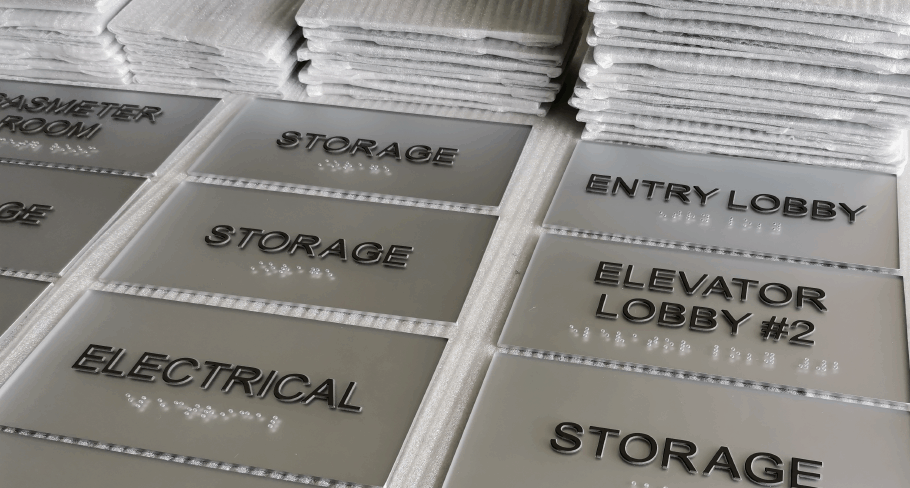
ADA-compliant signs typically feature a high-contrast color scheme (e.g., dark background with light text, or vice versa), non-glare finishes, and Grade 2 Braille. For permanent rooms, they must also include tactile (raised) characters and specific pictograms like the ISA symbol. See the article below for details:
3 Key Differences Between Federal and California Restroom ADA Signs
Do ADA signs need to be all caps?
Yes. For tactile signs, the text must be in a sans-serif font and all uppercase. Additionally, the characters should not be overly bold, condensed, or italicized to ensure maximum readability for visually impaired users.
What is the ADA symbol called?
The accessible symbol on ADA signs is called ISA, The International Symbol of Accessibility, part of an ISO standard (ISO 7001 Graphic Symbols – Public Information Symbols).
Do ADA signs have to be blue?
Not necessarily. The key is to ensure contrast. If your sign has a white background, you should use a dark font color like blue, black, or brown.
Do all ADA signs have braille?
Not necessarily. According to ADA guidelines, Braille is only mandatory for signs indicating permanent spaces (such as restrooms, exits, and offices); temporary signs (such as “Cleaning in Progress”), advertising billboards, or company logos are not.
However, in practice, to ensure full building compliance and maximize accessibility for visually impaired individuals, it is recommended that most signs involving functional identification include Braille to avoid potential legal disputes.
How to install an ADA room signs?
In short, it’s typically installed on the latch side of the door, 48 inches to 60 inches from the ground. However, in practice, California has stricter requirements than the federal government. Please refer to below article for details:
How to Install ADA Compliant Restroom and Room Signs?
What are the differences between ADA, ADAAG, and 2010 ADA?
ADA is the law, ADAAG was an earlier accessibility technical guideline, and the 2010 ADA is the currently used mandatory legal standard for the accessibility field. Please refer to below article for details:
What are the Differences of the ADA, ADAAG, 2010 ADA Standard, ANSI A117.1 and California Title 24?
What is an ADA inspector?
An ADA-certified inspector helps you identify and address accessibility issues before they escalate. They carry out thorough evaluations and inspections to ensure your business meets the required standards and help you avoid non-compliance consequences.
What is a Certified Access Specialist (CASp)?
Certified Access Specialists (CASp) are experts in ADA and California Building Code (Accessibility) compliance. CASp Inspectors are rigorously tested by the Division of the State Architect to demonstrate specialized knowledge of disability access requirements in the State of California.
What are the differences between California’s ADA signs and Federal’s?
The size requirements for Braille on California’s ADA signs differ significantly from those of the federal ADA standard. The federal ADA standard allows for a range of spacing between dots in the same cell as well as dots in adjacent cells. California specifies that these two spacings must be the maximum values allowed in the federal ADA standard.
For more details please refer to:
What’s the Difference between Federal Braille Signs and California Braille Signs?
Does a residential bathroom have to be ADA compliant?
ADA compliance in private homes isn’t legally required, but using the guidelines improves long-term livability. ADA bathroom layout focuses on clear floor space, turning space, and fixture placement that allows for wheelchair access.
What fonts are acceptable for ADA tactile signs?
San-serif fonts are accepted fonts for accessibility. Some highly recommended fonts are:
- Verdana (sans-serif)
- Tahoma (sans-serif)
- Arial (sans-serif)
- Helvetica (sans-serif)
- Lucida Sans (sans-serif for Windows)/Lucida Grande (sans-serif for Mac)
What is the DDA sign?
DDA stands for Disability Discrimination Act, which is an accessibility act in the UK, and was officially replaced by the Equality Act 2010 on October 1, 2010.
A DDA sign refers to a signage that complies with the DDA Act.
Although the DDA Act has been superseded, term “DDA signs” are still widely used in the industry.
What is BS 8300?
BS 8300(British Standard 8300) is a British Code of Practice that sets out the requirements of how buildings should be designed, constructed and maintained to meet the needs of disabled people as well as create an accessible and inclusive environment for them.
In the field of accessibility, BS8300-2:2018 is currently the technical compliance for signage under the Equality Act 2010 in the UK. For details, please refer to below article:
BS 8300-2 Guide: Installing Tactile & Braille (DDA) Signage in UK
What is the AODA sign?
AODA stands for Accessibility for Ontarians with Disabilities Act, which is an an accessibility act enacted in 2005 in Ontario, Canada.
Although the AODA is an Ontario law, it has become the de facto accessibility law in Canada because the federal accessibility law, the ACA, was not enacted until 2019.
An AODA sign refers to a signage that complies with the AODA Act. Generally, when people mention the AODA sign, they are referring to the Canadian tactile Braille sign.
What is CSA B651?
CSA B651 stands for Accessible Design for the Built Environment, a Canadian National Technical Standard. The latest version is the 2023 Edition (B651:23). It is a Canadian accessibility technical standard. For details, please refer to below article:
Ordering Tactile Braille Signs in Canada: An AODA & CSA B651 Compliance Guide
What is Marburg Braille?
Marburg Braille refers primarily to the Marburg Medium standard for Braille, a specific set of dimensions optimized for tactile readability on pharmaceutical packaging and labels. It ensures consistency across languages, materials, and production methods, as endorsed by European and North American standards.
Marburg Braille has two standards: medium and large.
Germany, Italy, and Switzerland use Marburg Large Braille, while France and Poland use Marburg Medium Braille.
For more details please refer to:
How to Install Tactile Braille Signs in Europe?
What is the Australian AS 1428.1 Guide?
AS 1428.1 is an Australian accessibility guideline. Together with the Australian National Construction Code (NCC), it forms the Australian accessibility technical standards, which are the standards that must be followed when manufacturing and installing tactile braille signs in Australia. Please refer to below article for details:
Ordering Tactile and Braille Signs for Australia: NCC & AS 1428.1 Guide
How many grades are there in English Braille? How do different countries decide?
English Braille, also known as Unified English Braille (UEB), is mainly divided into two grades: Grade 1 Braille and Grade 2 Braille.
Grade 1 Braille does not use contractions, while Grade 2 Braille does. In the field of braille signage, the United States, the United Kingdom, and Ireland primarily use Grade 2 Braille, while Australia and New Zealand use Grade 1 Braille. Canada uses both. In Europe, due to the multilingual nature of many countries, there is no unified standard; it depends on the specific circumstances. For more details, please refer to below article:
Grade 1 vs. Grade 2 Braille: Differences and Global Compliance Standards for Braille Signage
What are tactile Braille signs made of? How are they manufactured?
Currently common materials for tactile Braille signs include photopolymer, acrylic, stainless steel, aluminum, brass, etc.
Since each material has its own unique properties, different manufacturing methods are required to achieve the best results, the common manufacturing methods for Tactile Braille Signs currently include Photopolymer, Thermoforming, Raster/Appliqué, Engraving/Etching, and Sandcarving; in addition, UV Printing, 3D Printing, Injection Molding, Casting, and Stamping are also often used for specific projects or as extended processes.
For more details please refer to:
How Many Ways to Make Tactile Braille Signs?
Why technical expertise matters in signage?
After all, a sign is more than just a piece of material; it’s a critical component of building accessibility. FT Signage‘s deep dive into international standards ensures that when you work with us, you’re partnering with a manufacturer who speaks your language—and your country’s regulations.
Ready to start your custom order? Contact US for high-quality, compliant signage solutions tailored to your needs.
References:
The International Symbol of Accessibility (ISA)
2010 ADA Standards for Accessible Design
Disability and the Equality Act 2010