As a country that occupies an entire continent, Australia boasts many unique plant and animal species found nowhere else in the world. Similarly, in the field of accessible signage, Australia maintains its own set of distinctive standards.
For signage businesses, Australia’s Braille signage standards differ significantly from those in other parts of the world. From unique Braille indicators to stringent brightness and contrast requirements, these details form the foundation of Australia’s accessible environment. This article will delve into this topic, analyzing how to create fully compliant Australian Braille signage.
What are the Accessibility Laws and Standards in Australia?
Back in 1992, the Australian Federal Government passed the Disability Discrimination Act 1992 (DDA). The DDA established the legal right of all disabled persons to “equal access” to public spaces. As the highest level of federal law, the DDA set the tone of “mandatory compliance,” but the specific implementation details were defined by more detailed building codes.
To translate the principles of the DDA into mandatory building guidelines, Australia subsequently introduced the National Construction Code (NCC) and Premises Standards 2010. The NCC not only clearly defines “which buildings and which locations” must have signage installed, but also makes strict, legally binding regulations on the installation height and wall location.
Meanwhile, Australia has introduced the AS 1428.1-2021 technical standard for architects, designers, owners, and regulatory agencies. It covers detailed design aspects, such as the stroke thickness of tactile characters, mandatory sans-serif font requirements, and the need for precise Braille dot specifications to comply with ABA regulations.
Therefore, in Australia, it is essential to consider both NCC and AS 1428.1 to ensure signage compliance and effectively avoid legal risks under the DDA framework.
Below is a summary and comparison table of Australian accessibility-related laws, codes, and standards:
| Hierarchy | Name | Core Role |
|---|---|---|
| Law | DDA 1992 | Establishes the right to “Equal Access” and serves as the overarching legal framework for compliance. |
| Code | NCC / Premises Standards | Mandatory Requirements: Specifies where signage is required and provides legally binding installation heights and locations (accurate to mm). |
| Standard | AS 1428.1-2021 | Technical Core: Defines form of the signs, tactile character dimensions, fonts, luminance contrast, etc. |
| Standard | ABA (Australian Braille Authority) | Braille Guidelines: Defines the specific braille dot dimensions and spacing in Australia. |
What Information is Required on Australian Tactile and Braille Signs?
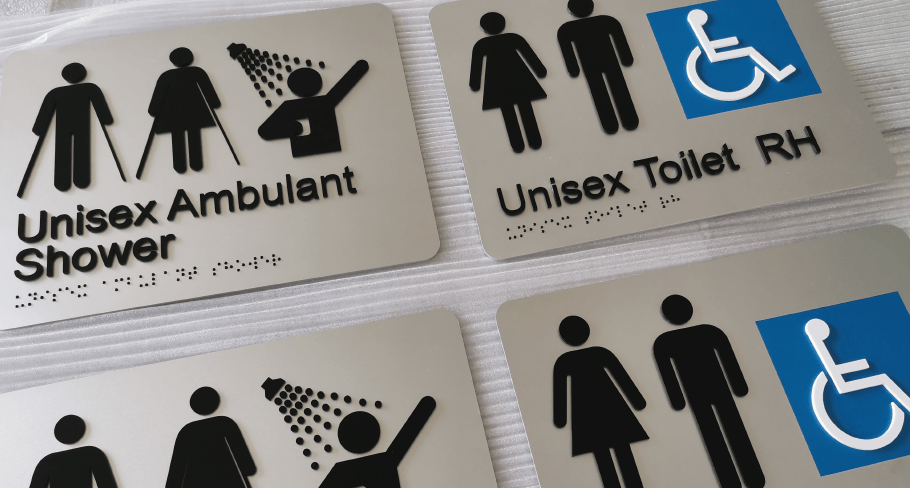
Generally speaking, Tactile and Braille Signs should include at least symbols, tactile text, and Braille.
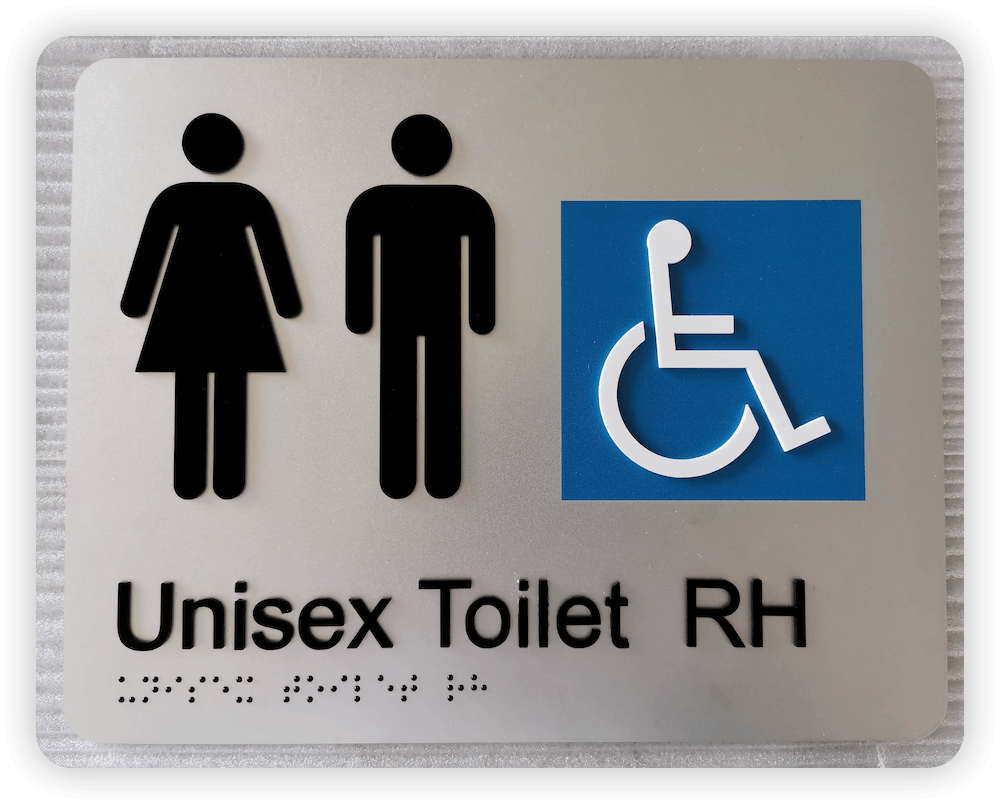
Taking the unisex accessible toilet as an example, the Australian accessibility technical standard AS 1428.1-2021, section 5.1, Form of signs, specifies that toilet signs should include the following:
(1) Raised and visual versions of the international symbol of access.
(2) Raised and visual versions of the male and female symbols.
(3) Raised text that shall be in title case (e.g. Male Toilet).
(4) Braille that fully describes the visual information displayed by symbols and raised text.
(5) Signs for unisex accessible facilities shall be provided with the letters LH or RH to indicate a left-hand or right-hand side transfer onto the WC pan.
As shown in the image below:
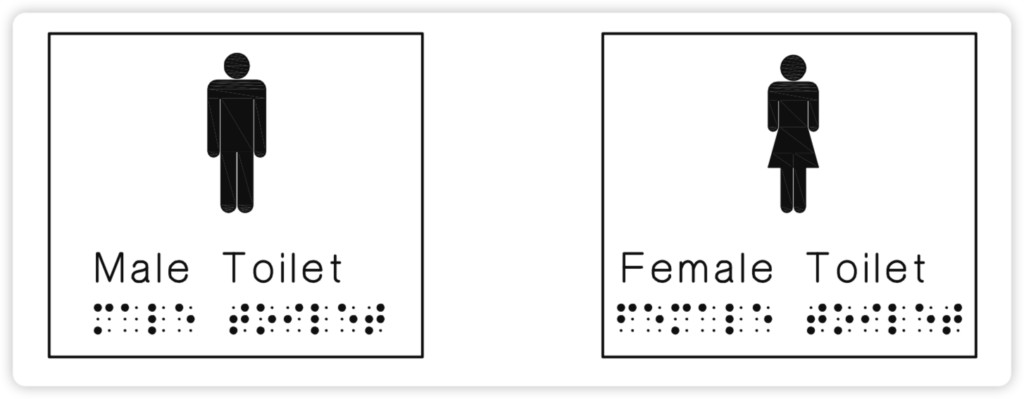
If it is a male/female accessible toilet, then it includes the following three items:
raised visual male symbol or female symbol;
words “Male Toilet” or “Female Toilet” as visual, raised text;
Braille that fully describes the symbol and raised text.
As shown in the image below:
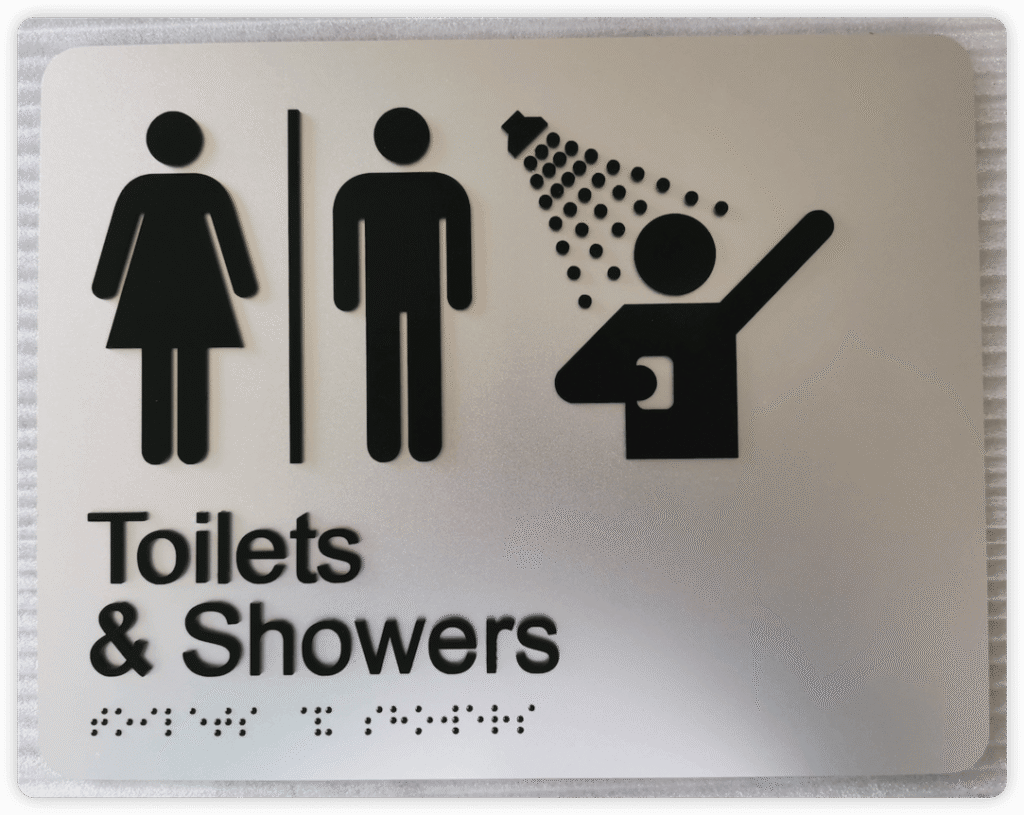
Where the facilities for male and female are separate, a dividing line should be placed between each symbol, as shown below:
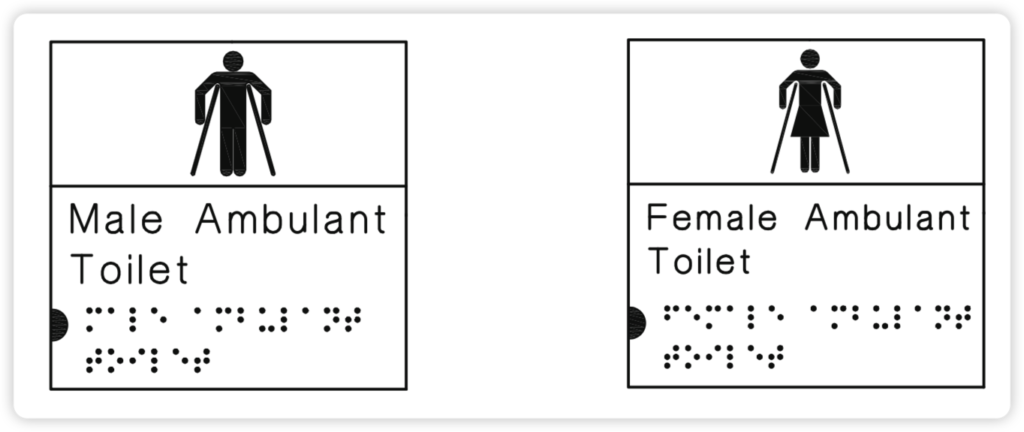
A sanitary compartment for people with ambulant disabilities shall be identified, as shown in the image below:
Symbols
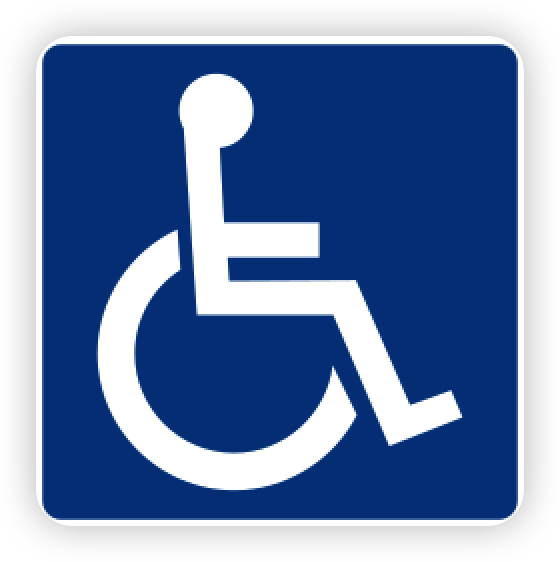
Access symbols in Tactile and Braille Sign should adopt the international standard, which is ISA Symbol, as shown in the following figure:
Tactile Text
The following requirements apply to tactile text:
Title case has the first letter of each word capitalized and the rest are lower case. Short articles, prepositions and conjunctions are not capitalized;
The minimum font size shall be 20 mm san serif(Helvetica and Arial are san serif fonts);
Where words are used, they shall be displayed horizontally;
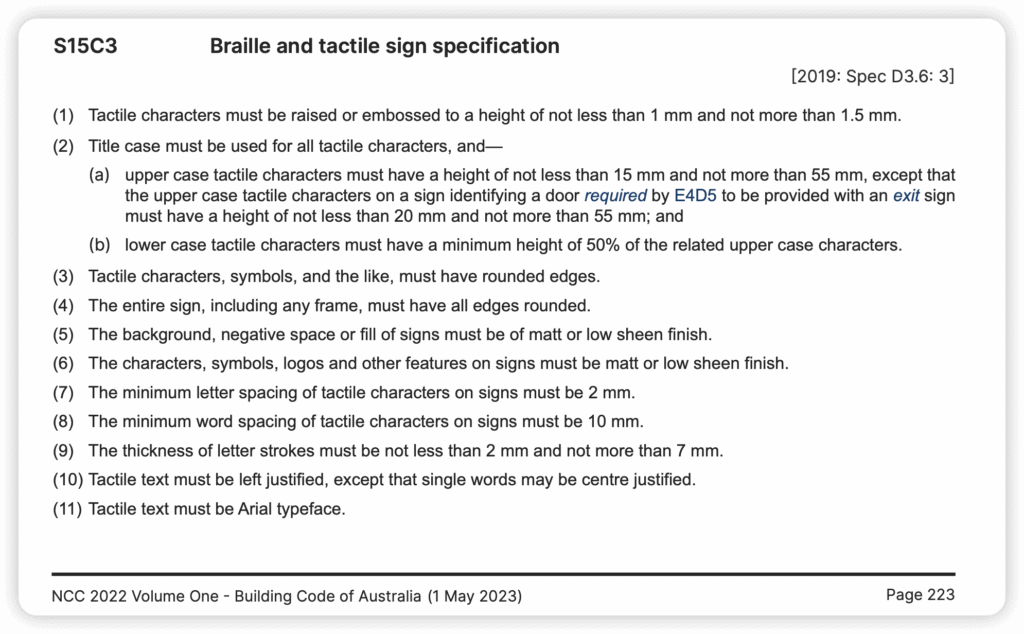
More detailed requirements for tactile text are listed in the “NCC, S15C3 Braille and tactile sign specification”:
Braille
Braille shall be Unified English Braille (UEB), Grade 1, uncontracted;
Braille numerals shall be preceded by a Braille numerical sign;
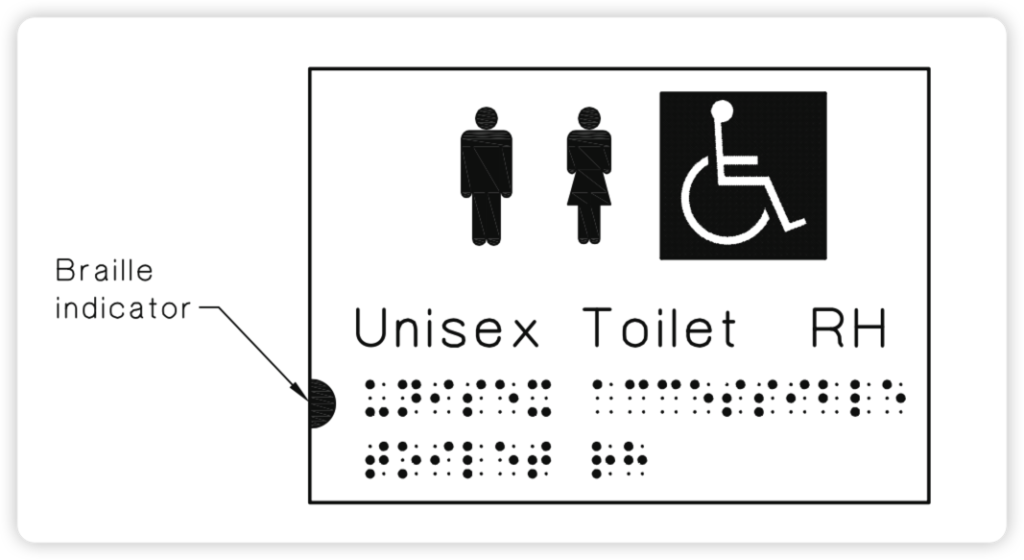
The Braille indicator is only used where there are multiple lines of text. It indicates the location of the first line of Braille.
A Braille indicator is shown in the following figure:
The dot spacing and dot size in Braille should comply with the technical specifications of the Australian Braille Authority (ABA).
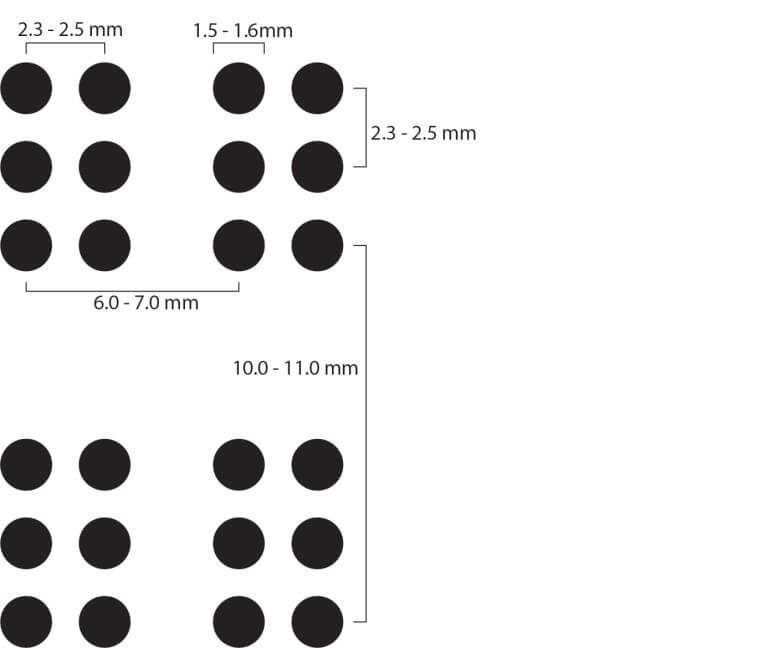
The distance between dots should follow the following specifications:
Horizontal or vertical distance from centre to centre of adjacent dots in the same cell = 2.3 mm – 2.5 mm
Horizontal distance from centre to centre of corresponding dots in adjacent cells = 6.0 mm – 7.0 mm
Vertical line spacing from centre to centre of nearest corresponding dots in adjacent lines = 10.0 mm – 11.0 mm
The dot size should conform to the following specifications:
dot base diameter = 1.5 mm – 1.6 mm
dot height = 0.6 mm – 0.9 mm
As shown in the image below:
What are the Luminance Contrast Requirements for Australian Braille Signage?
Australia has clear regulations regarding visual contrast of signage, specifically in NCC, S15C4 Luminance contrast, which requires the following:
(a)The background, negative space, fill of a sign or border with a minimum width of 5 mm must have a luminance contrast with the surface on which it is mounted of not less than 30%.
(b)Tactile characters, icons and symbols must have a minimum luminance contrast of 30% to the surface on which the characters are mounted.
(c)Luminance contrasts must be met under the lighting conditions in which the sign is to be located.
Therefore, the key word is 30%, which means that the minimum requirement for visual contrast or luminance contrast is 30%.
However, this requires good lighting conditions. In NCC, S15C5 Lighting, the lighting requirements are as follows:
Braille and tactile signs must be illuminated to ensure luminance contrast requirements are met at all times during which the sign is required to be read.
Although no specific requirement is given for how bright the light should be, the ultimate requirement is that the luminance contrast of the signage must be at least 30% in both natural and artificial light environments to ensure that visually impaired individuals can recognize the signage content.
How Should Tactile and Braille Signage Be Installed in Australia?
In AS 1428.1-2021, section 5.1, Form of signs, clearly specifies the height at which signage should be installed:
Facilities shall be identified by the use of raised text, Braille, and symbols if required. The identification shall be between 1200 mm and 1600 mm above finished floor levels.
Furthermore, in “NCC, S15C2 Location of braille and tactile signs”, it provides even more specific details regarding the installation location:
Signs including symbols, numbering and lettering must be designed and installed as follows:
(a) Braille and tactile components of a sign must be located not less than 1200 mm and not higher than 1600 mm above the floor or ground surface.
(b) Signs with single lines of characters must have the line of tactile characters not less than 1250 mm and not higher than 1350 mm above the floor or ground surface.
(c) Signs identifying rooms containing features or facilities listed in D4D7 must be located—
(i)on the wall on the latch side of the door with the leading edge of the sign located between 50 mm and 300 mm from the architrave; and
(ii)where (i) is not possible, the sign may be placed on the door itself.
(d) Signs identifying a door required by E4D5 to be provided with an exit sign must be located—
(i) on the side that faces a person seeking egress; and
(ii) on the wall on the latch side of the door with the leading edge of the sign located between 50 mm and 300 mm from the architrave; and
(iii) where (ii) is not possible, the sign may be placed on the door itself.
In short, Australian Tactile and Braille Signage should be installed on latch side of the door, 50mm to 300mm from the door frame and 1200mm to 1600mm from the ground.
FAQ
What Braille is used in Australia?
Australia uses the Unified English Braille, Grade 1, uncontracted, and has a Braille indicator for positioning the first line in the case of multi-line Braille.
Is Braille mandatory on signage in Australia?
Yes, according to Australian DDA law, all disabled persons have the right to “equal access” the public places, therefore, a qualified signage must include a braille to ensure that blind people can also access it.
Why do Braille signs in Australia often have multiple lines of Braille?
It is mainly affected by the following two factors:
- Braille Grade Requirement (Grade 1 Braille): To meet the reading needs of all users (including beginners), Australian standards mandate the use of Grade 1 (Uncontracted) Braille. Since every letter must be represented individually, the text length is significantly greater than the Grade 2 (Contracted) Braille commonly used in North America.
- Integrated Information: Australian signage often carries more information. For example, an accessible toilet sign must not only state “Toilet” but also integrate floor levels or specific facility features (e.g., “Left-hand side transfer” or “Right-hand side transfer”). This leads to a substantial increase in the amount of information to be conveyed.
Therefore, when Braille must be displayed in multiple lines due to its length, in order to help users quickly find the starting point of reading, the standard requires an additional Braille indicator to be added to the left of the multi-line Braille for the first line location.
Take Away
In summary, to legally customize and install an Australian Braille sign, remember at least the following three points:
- The signage includes symbols (such as the international standard ISA symbol, male or female symbols), minimum 20 mm sans-serif tactile text, ABA-compliant brailles, and in some cases, an indicator for RH or LH, as well as other information such as floor level and directional arrows.
- Meets at least 30% visual/luminance contrast requirements;
- Installed on the latch side, 50mm–300mm from the door frame, and 1200mm–1600mm from the ground.
Of course, this article cannot cover all the details. For more details, you can refer to the NCC and AS 1428.1 technical standards.
Building an inclusive environment starts with getting the details right. FT Signage is dedicated to tracking the latest shifts in global and local accessibility codes, ensuring our clients stay ahead of the curve. We invite you to leverage our expertise for your next Braille signage order—connect with us to explore how we can support your accessibility goals.
References:
The Disability Discrimination Act (1992)
Australian Braille Authority: Physical Specifications for Braille