Ontario, home to Canada’s federal capital Ottawa and the prosperous city Toronto, has the largest population in Canada and has always been at the forefront in the field of accessibility.
As early as 2005, Ontario enacted the Accessibility Act AODA, and the Canadian federal government did not promulgate the federal-level accessibility law ACA until 2019. This resulted in Ontario’s accessibility standards becoming Canada’s de facto national standards.
Therefore, any tactile braille signs involving Canada can hardly avoid AODA.
Although Ontario’s AODA and its technical guide IASR have mandated and standardized accessible from the legal and technical levels respectively, to make and install Canadian tactile braille signs, you must carefully read CSA B651.
To sum it up in one sentence:
In Canada, AODA tells you ‘must do’, while CSA B651 tells you ‘how to do’.
The Difference Between AODA, ACA, IASR and CSA B651
In order to help you sort out the differences between AODA, ACA, IASR and CSA B651, I have summarized them for you in the form of a table. I hope you can fully understand the differences between them and know that CSA B651 is the gold standard for doing tactile braille signs in Canada:
Acronym
Full Name
Role/Positioning
Core Function
First Edition
Latest Version / Revision
AODA
Accessibility for Ontarians with Disabilities Act
Provincial Law (Ontario)
Defines the legal obligations and timelines for organizations within Ontario to achieve accessibility.
The “Official Manual” for AODA, providing detailed explanations on how the law is implemented in different scenarios.
2011
2023 Revision
CSA B651
Accessible design for the built environment
National Technical Standard
The “Gold Standard.” Provides precise millimeter-level parameters (e.g., height, installation position) required for tactile braille signs.
1990
2023 Edition (B651:23)
Braille Standard
Canada has its own unique views on Braille sign standards, so Canada’s braille signs standards are completely different from other countries.
The 10-Word Rule
In order to be friendly to beginners of Braille masters, Canada has the following regulations (extracted from CSA/ASC B651:23, 4.6.6.1 General):
Uncontracted braille shall be used for signs that have 10 words or less, and contracted braille for signs with more than 10 words.
This is known in the industry as The 10-Word Rule: Grade 1 Braille for 10 words or less, Grade 2 Braille for more than 10 words.
Braille Dot Spacing
Although Ontario’s IASR guidelines and CSA B651:23 establish the legal and spatial installation standards for signage, for the physical manufacturing accuracy of braille dots, you need to refer to the more detailed CAN-ASC-2.4 technical specifications.
In CAN-ASC-2.4 – Wayfinding and Signage, 12.8.1 Braille dots, it is described like this:
Braille shall:
have dots that are domed and provide:
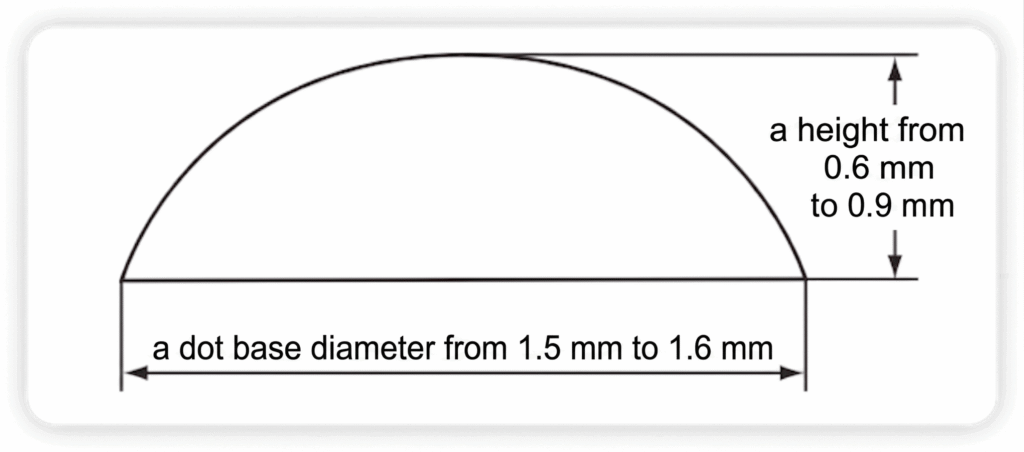
a dot base diameter from 1.5 mm to 1.6 mm;
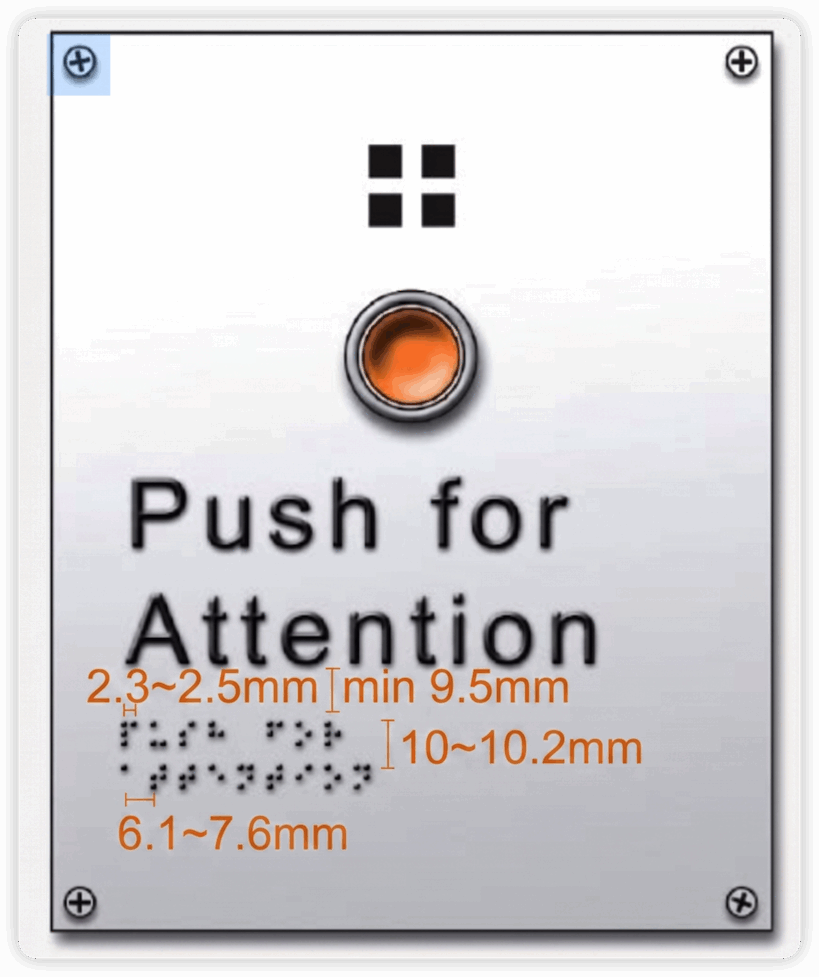
a distance between two dots in the same cell from 2.3 mm to 2.5 mm;
a distance between corresponding dots in adjacent cells from 6.1 mm to 7.6 mm;
a dot height from 0.6 mm to 0.9 mm; and
a distance between corresponding dots from one cell directly below from 10 mm to 10.2 mm.
be separated by a minimum of 9.5 mm from any other tactile characters and 9.5 mm from raised borders and decorative elements.
In order to facilitate your understanding, I have made the tables and diagrams as follows:
Feature
Specification (Requirement)
Dot Shape
Domed or rounded
Dot Base Diameter
1.5 mm – 1.6 mm
Dot Height
0.6 mm – 0.9 mm
Inter-dot Spacing (Within the same cell)
2.3 mm – 2.5 mm
Inter-cell Spacing (Between adjacent cells)
6.1 mm – 7.6 mm
Line Spacing (Distance between corresponding dots in cells below)
10.0 mm – 10.2 mm
Clearance (Exclusion Zone)
Minimum 9.5 mm from tactile characters, borders, or decorative elements
Character and Luminance Contrast
A qualified tactile braille sign not only has precise requirements for its braille, but also has clear requirements for character and luminance contrast (extracted from CSA/ASC B651:23, 4.6.3 Characters):
On signs, letters and numerals shall
a) use a sans serif font;
b) have Arabic numbers;
c) have a width-to-height ratio between 3:5 and 1:1;
d) have a stroke-width-to-height ratio between 1:5 and 1:10;
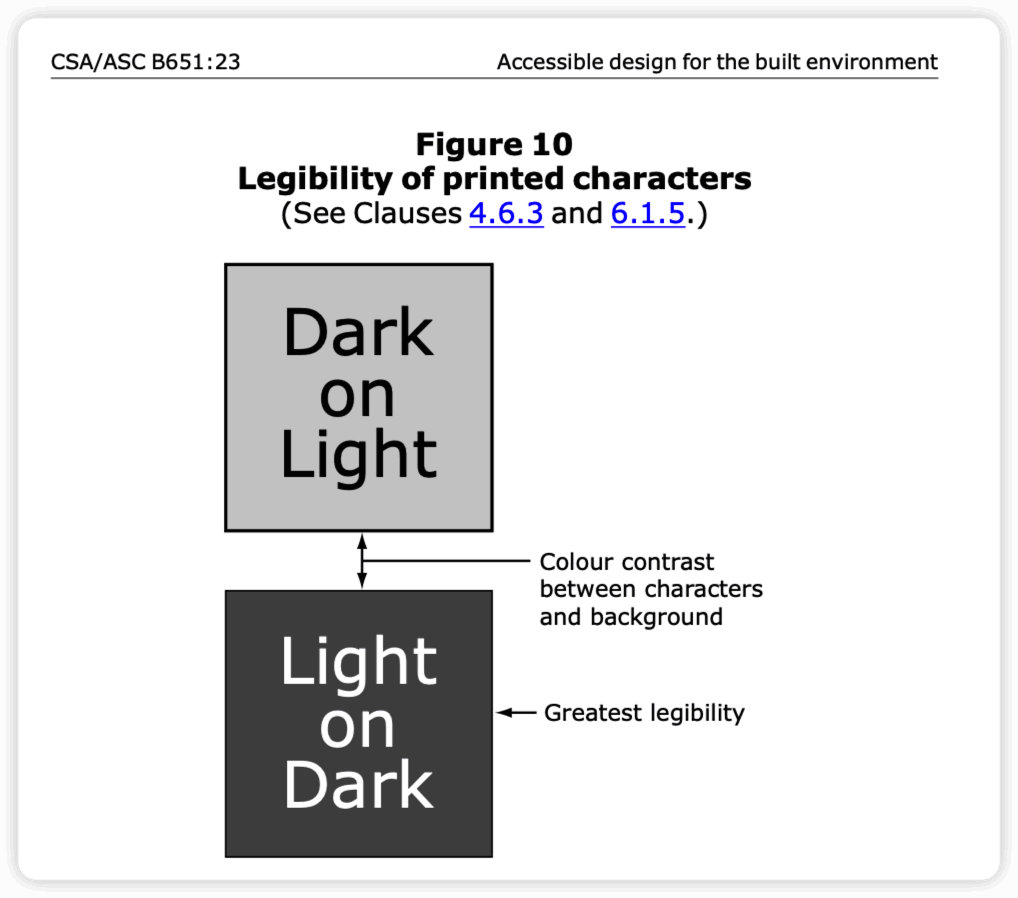
e) be luminance (colour) contrasted by at least 70% with their background;
f) have the character height sized relative to the intended viewing distance; and
g) use an upper case “X” for character measurement.
What needs further elaboration here is character height and luminance contrast.
Character Height
Character height is not static, but changes according to distance, as shown in the following table. This table lists the minimum character heights based on the maximum viewing distance (excerpted from CSA/ASC B651:23, Table 7 Character height relative to viewing distance):
Minimum character height, mm
Maximum viewing distance, mm
25
750
50
1500
75
2250
100
3000
150
4500
200
6000
250
7500
300
9000
Luminance Contrast
In order to ensure that visually impaired people can easily identify the signage, Canada requires that the signage use a glare-free surface to prevent glare. It also requires that the luminance (colour) of the signage contrast by at least 70% with their background, and gives examples:
Examples of colours that contrast more than 70% are navy blue with matte white (95%), apple green with white (72%), and silver with saddle brown (70%).
And some color combinations are explicitly excluded. The following color combinations are not in compliance with the regulations:
Colour combinations that should be avoided include yellow/grey, white/grey, yellow/white, blue/green, red/green, black/violet, and red/black.
Tactile Braille Sign Installation
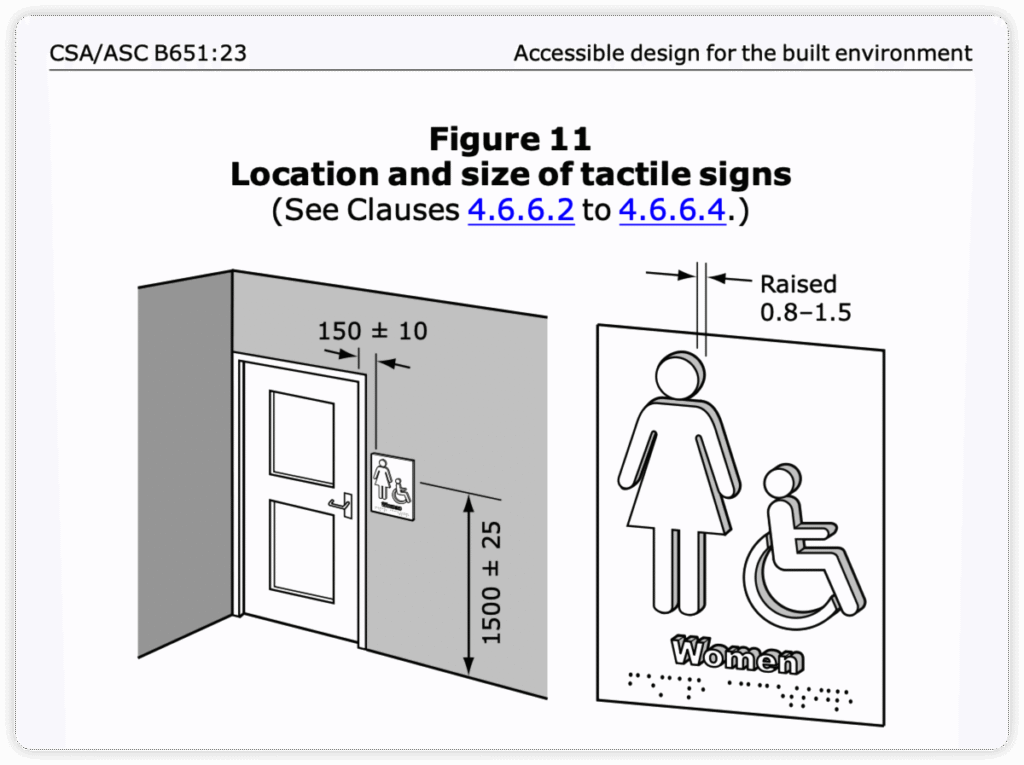
There are also very clear instructions in CSA B651 on how to install tactile braille signs in Canada (extracted from CSA/ASC B651:23, Figure 11 Location and size of tactile signs):
This figure demonstrates the location and size of a tactile sign. The graphic shows a washroom sign placed 150 ± 10 mm from the outer edge of a door frame, on the latch side, and 1500 ± 25 mm from the floor. The washroom sign is provided with a raised gender pictogram and raised International Pictogram of Access, both of which protrude 0.8 mm to 1.5 mm. Under the pictograms is raised text indicating a women’s gendered bathroom and beneath that text is the braille.
As shown below:
CSA B651 uses the women’s bathroom as a scene to vividly illustrate the elements that a qualified washroom tactile sign should include:
a raised gender pictogram;
a raised International Pictogram of Access;
pictogram protrude 0.8 mm to 1.5 mm;
Under the pictograms is raised text “Women”;
beneath raised text “Women” is the braille;
The core points of installing this washroom tactile sign are also very simple:
Install on the door latch side, 150 ± 10 mm from the door frame;
The installation height is 1500 ± 25 mm from the ground;
FAQ
Is Ontario the only province required to comply with AODA?
Yes, AODA is only available in Ontario. However, other Canadian provinces (such as British Columbia, Manitoba, and Nova Scotia) also have their own accessibility laws. In addition, federally regulated industries (banking, telecommunications, interprovincial logistics) are subject to the Canadian Accessibility Act (ACA). Although the names of the bills vary, the nationally recognized technical standard CSA B651 is generally referenced when creating tactile braille signs.
Do tactile braille signs have to include French in Canada?
Depends on jurisdiction. Bilingualism (English/French) is a legal requirement in all federal government agencies and inter-provincial agencies. In Quebec, French signage is mandatory and must be dominant according to the Charter of the French Language. In other provinces, this often depends on the specific requirements of the building owner or local government.
When is Grade 1 Braille used in Canada?
Use only for very simple single-word identification or purely numeric room numbers (such as “EXIT”), usually equal to or less than 10 words, and Grade 2 Braille for more than 10 words.
Take Away
In fact, no matter which country it is in, the installation of tactile braille signs involves these three points: whether the signage content complies, whether the visual contrast complies, and whether the installation location and height comply.
Specific to Canada, in order to ensure that your tactile braille signs comply with AODA and CSA, please keep the following four points in mind:
Braille:Remember The 10-Word Rule, use Grade 1 Braille for 10 words or less, use Grade 2 Braille for more than 10 words, and reserve at least 9.5 mm exclusion zone;
Character:Use a sans serif font, stroke width-to-height ratio between 1:5 and 1:10, character width-to-height ratio between 3:5 and 1:1, character heights is based on the maximum viewing distance;
Contrast:luminance (colour) contrasted by at least 70% with their background, and avoid using low luminance contrast color combinations such as yellow/grey, white/grey, yellow/white, blue/green, red/green, black/violet, and red/black;
Installation: Install the signs on the latch side, 150 ± 10 mm from the door frame, and the installation height is 1500 ± 25 mm from the ground;
As a veteran expert in this industry, FT Signage not only focuses on the products themselves but also closely monitors industry standards and developments. This is to accurately grasp the needs of our clients and provide them with tailored products and services.
Welcome to contact us to discuss your customization needs and explore further details.
Hi, this is Nicole Zhong. I have several positions.On the one hand, I am responsible for the sales of FT Signage. Starting in 2018, many friends and clients supported me and brought the signs industry to my life and I am extremely proud of what I am doing.On the other hand, I am writing down my years’ experience in the signage industry and sharing what I know for custom signs with all interested people.