After receiving the freshly made restroom signs, the real challenge has just begun:
How to avoid costly mistakes during ADA restroom sign installation?
To put it simply, if you are in California, follow the requirements of California Title 24 and install both wall-mounted tactile signs on the latch side and geometric symbols on the door, with the installation height between 48 inches and 60 inches; if you are in other states, follow the requirements of the federal 2010 ADA and only need to install wall-mounted tactile signs on the latch side, with the installation height between 48 inches and 60 inches.
Although it sounds as simple as “hanging it up at a certain height”, in actual operation, there are devilish details everywhere.
Don’t worry, this article will break down the details of restroom signs installation for you, keeping you away from compliance risks.
Fixed with Glue or Screws?
Regarding the fixing method, there are no specific requirements in either the federal 2010 ADA or California Title 24 standards, as long as the installation can ensure that it is secure and will not fall.
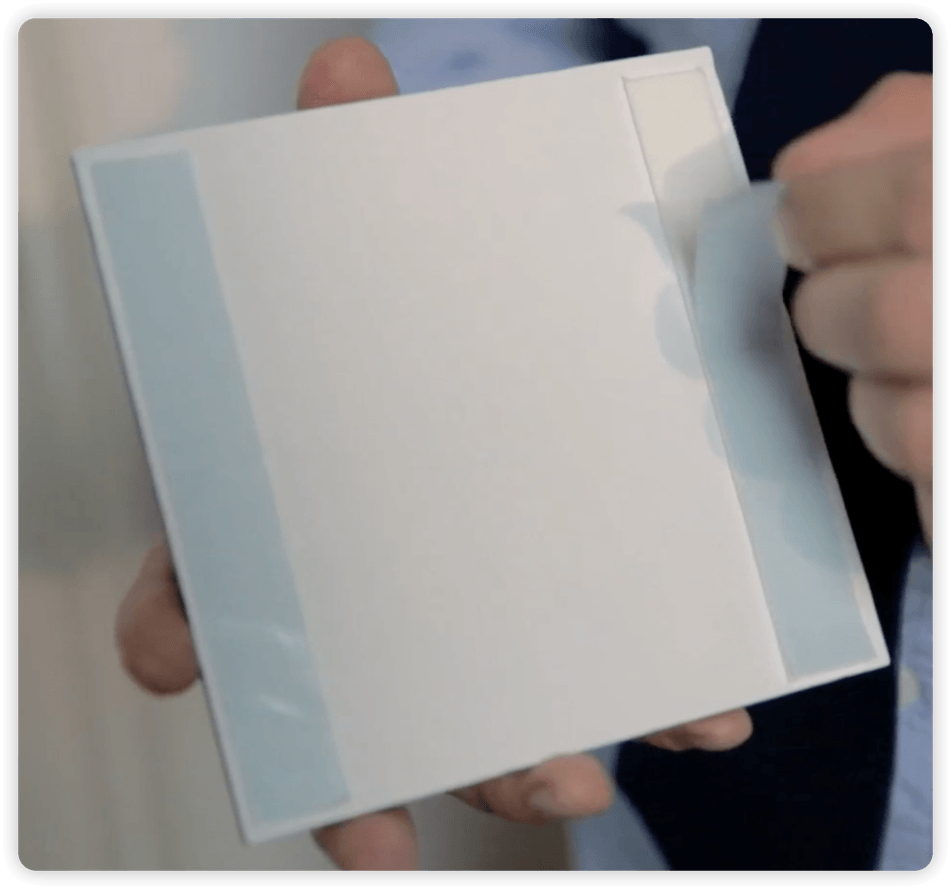
But generally speaking, the most common method is to stick them directly on the wall with adhesive tape. Therefore, the freshly made restroom signs you receive usually come with 3M adhesive tape, which not only sticks firmly to the wall, but is also very beautiful.
Adhesive Tape
But what if my wall surface is very rough(such as brick walls) and cannot be adhered with 3M adhesive?
Don’t worry, there is another installation solution to solve your problem.
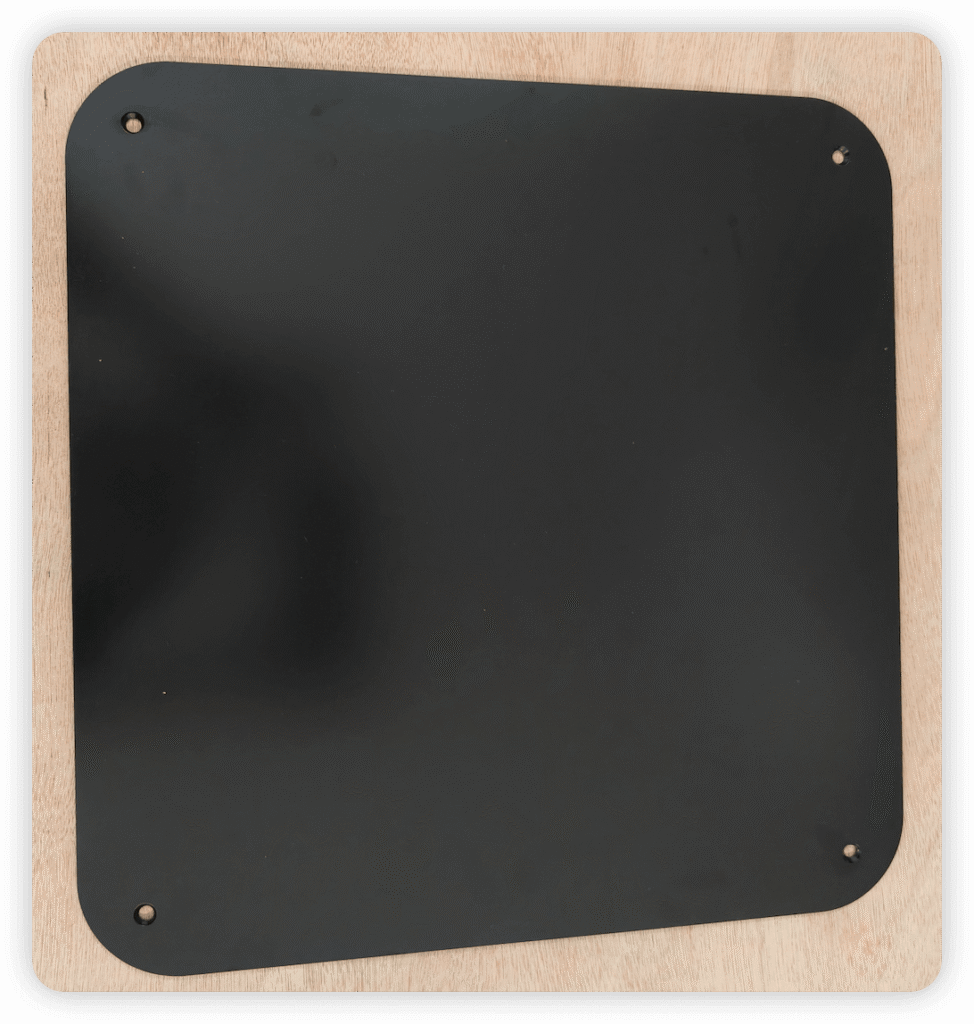
First, we need a smooth base plate with 4 screw holes:
Base Plate with 4 Screw Holes
Second, secure this base plate to the wall with screws;
Then, stick your restroom signs with 3M adhesive backing to the base plate that was just screwed to the wall. It will be very firm and beautiful.
In short, no matter what method of fixation is used, you only need to explain your wall material to your signage provider in advance, and he will customize a suitable wall fixation plan for you based on your situation.
What is the Installation Height of Restroom Signs?
Although both the federal 2010 ADA and California Title 24 state that the installation height is between 48 inches and 60 inches, where does the measurement start and end?
Federal 2010 ADA Installation Height Requirements
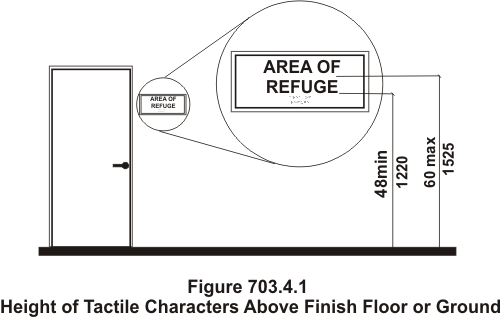
Since the federal 2010 ADA standard only requires the installation of wall-mounted tactile signs, the installation height of the federal standard is only for tactile signs, as detailed below (excerpted from 2010 ADA Standard, 703.4.1 Height Above Finish Floor or Ground):
Tactile characters on signs shall be located 48 inches (1220 mm) minimum above the finish floor or ground surface, measured from the baseline of the lowest tactile character and 60 inches (1525 mm) maximum above the finish floor or ground surface, measured from the baseline of the highest tactile character.
The schematic diagram is as follows:
California Title 24 Installation Height Requirements
Since California’s requirements for restroom signs include both wall-mounted tactile signs and geometric symbols, the situation in California is more complicated.
I. Wall-mounted Tactile Signs
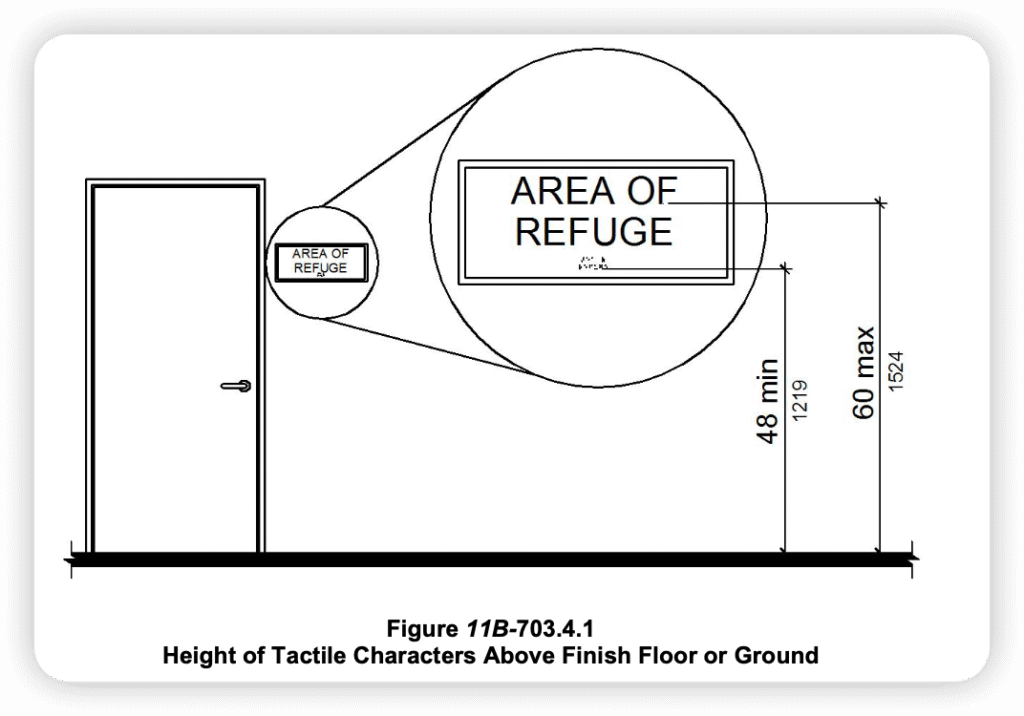
Regarding the installation height requirements for wall-mounted tactile signs, the details are as follows (excerpted from 2025 California Building Code (CBC), 11B-703.4.1 Height above finish floor or ground):
Tactile characters on signs shall be located 48 inches(1219 mm) minimum above the finish floor or ground surface, measured from the baseline of the lowest Braille cells and 60 inches (1524 mm) maximum above the finish floor or ground surface, measured from the baseline of the highest line of raised characters.
The schematic diagram is as follows:
Please note that the minimum installation height requirements for wall-mounted tactile signs in California are different from the federal standard. The Federal 2010 ADA (National Standard) measures it from the baseline of the lowest Tactile character, while the California Title 24 (California Standard) measures it from the baseline of the lowest Braille cells.
II. Geometric Symbols
Regarding the installation height requirements for geometric symbols on doors, the details are as follows (excerpted from 2025 California Building Code (CBC), 11B-703.7.2.6 Toilet and bathing facilities geometric symbols):
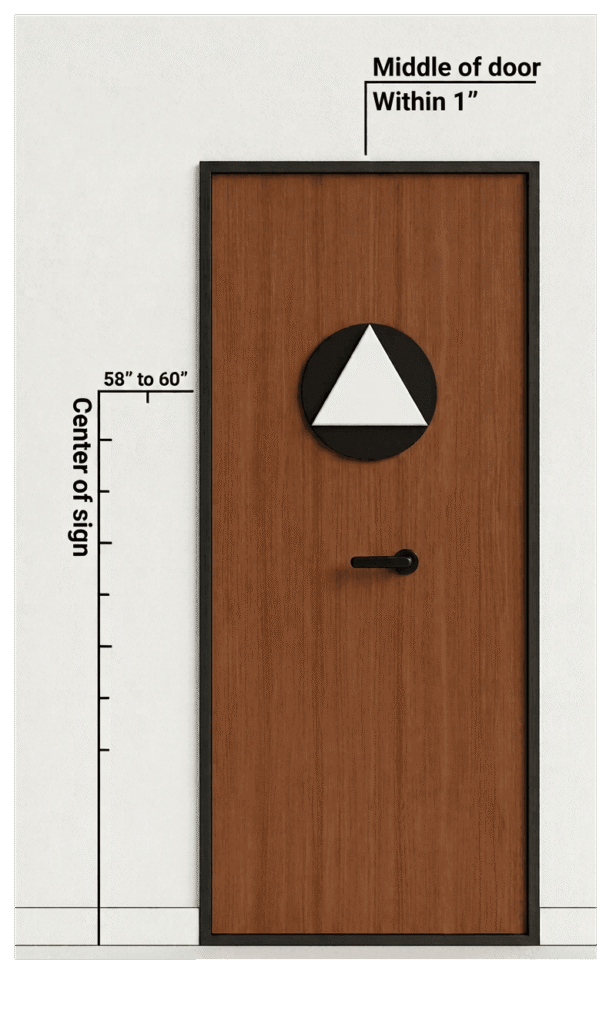
Geometric symbols at entrances to toilet and bathing rooms shall be mounted at 58 inches (1473 mm) minimum and 60 inches (1524 mm) maximum above the finish floor or ground surface measured from the centerline of the symbol. Where a door is provided the symbol shall be mounted within 1 inch (25 mm) of the vertical centerline of the door.
The schematic diagram is as follows:
California Geometric Symbols Installation Height
Tactile Sign Placement: Left or Right?
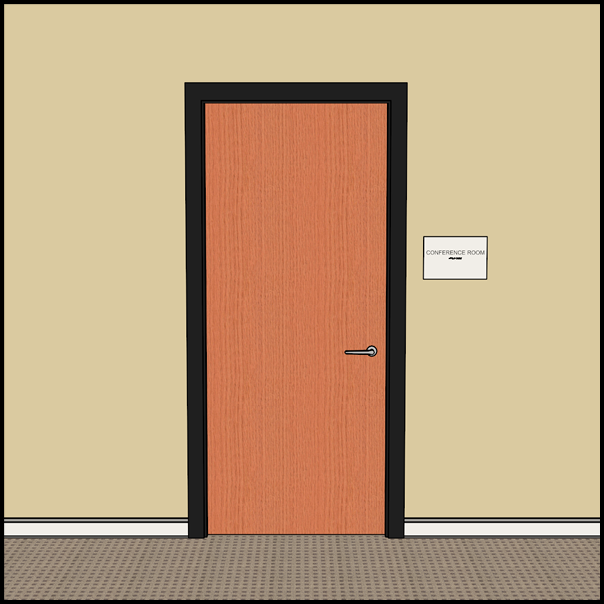
Some say it should be on the left side, and some say it should be on the right side, but in fact, it depends on the type of door and the size of the wall space. The details are as follows (excerpted from 2010 ADA Standard, 703.4.2 Location and 2025 California Building Code (CBC), 11B-703.4.2 Location, the federal and California requirements are exactly the same on this):
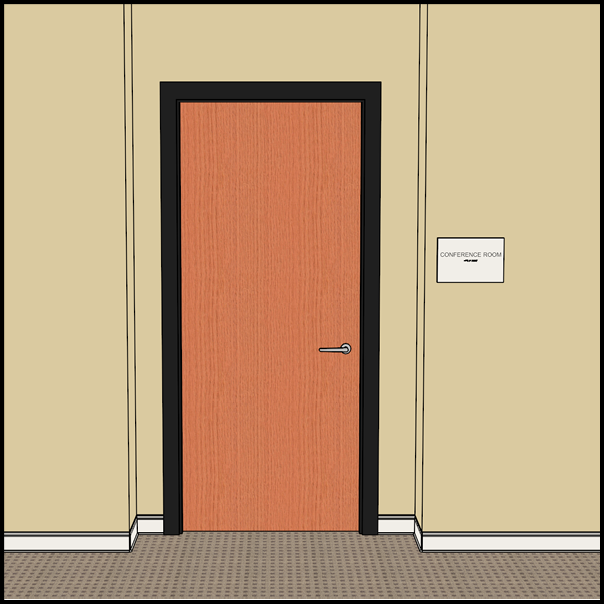
Where a tactile sign is provided at a door, the sign shall be located alongside the door at the latch side:
Sign on latch side of single door.
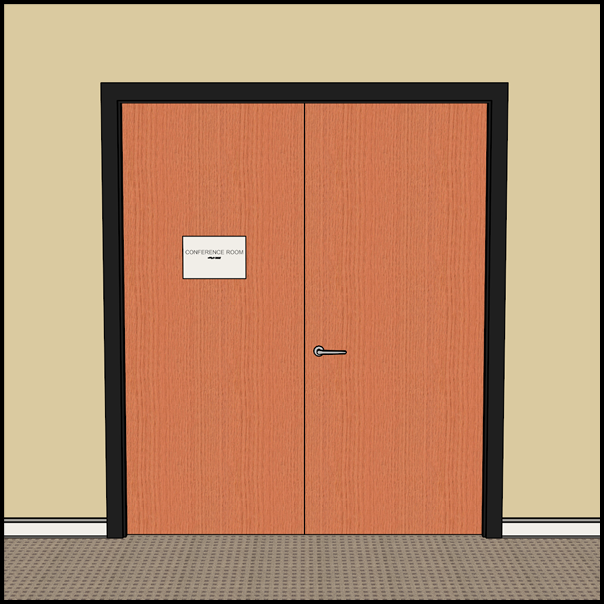
Where a tactile sign is provided at double doors with one active leaf, the sign shall be located on the inactive leaf:
Sign on inactive leaf at double-door entry.
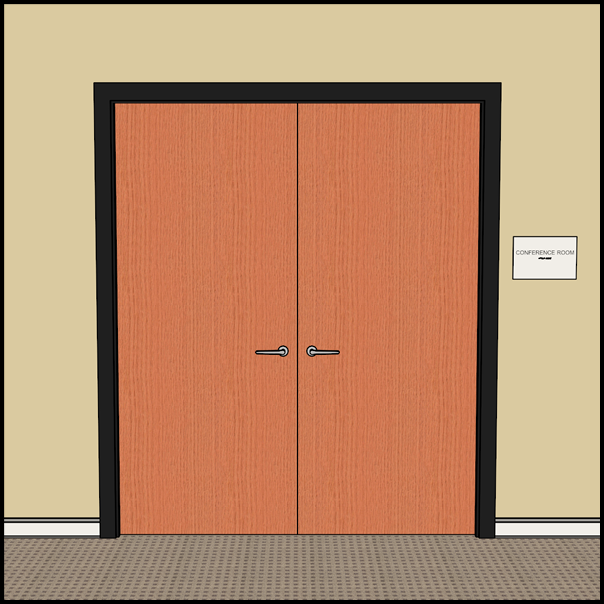
Where a tactile sign is provided at double doors with two active leafs, the sign shall be located to the right of the right hand door:
Sign at right-side hinge side of double-door entry with two active leaves.
Where there is no wall space at the latch side of a single door or at the right side of double doors, signs shall be located on the nearest adjacent wall:
Recessed door with sign on adjacent wall.
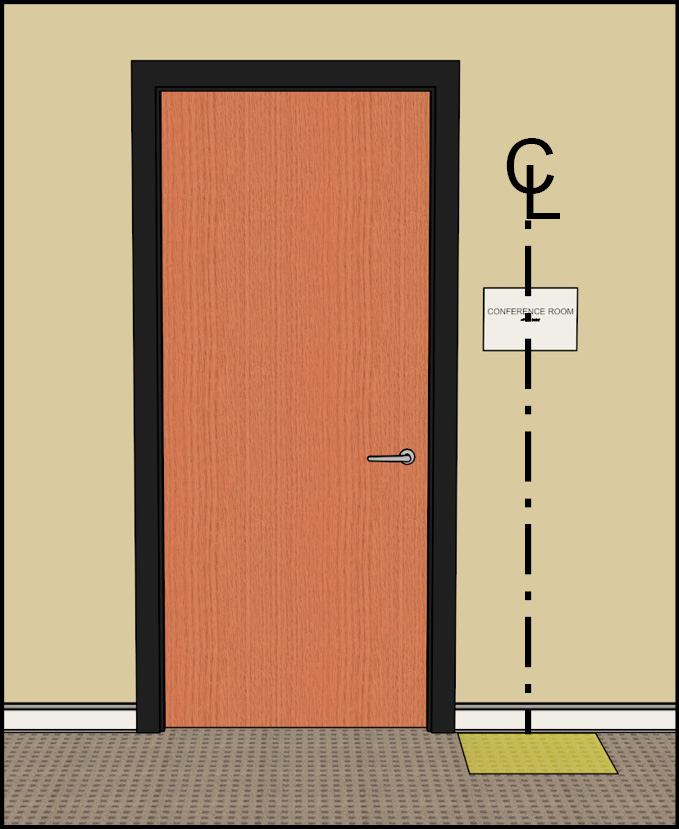
Tactile Sign Placement: How Far from Door Frame?
The answer given by many people is 9 inches.
But this answer is neither wrong nor right, only not enough.
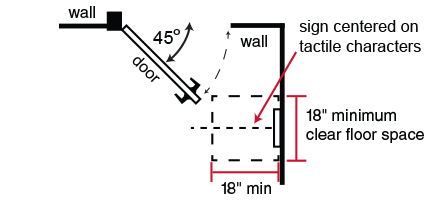
Because neither the federal 2010 ADA nor California Title 24 clearly requires how far the tactile sign should be from the door frame, they only require the space directly in front of the tactile sign. The details are as follows (excerpted from 2010 ADA Standard, 703.4.2 Location and 2025 California Building Code (CBC), 11B-703.4.2 Location, the federal and California requirements are exactly the same on this):
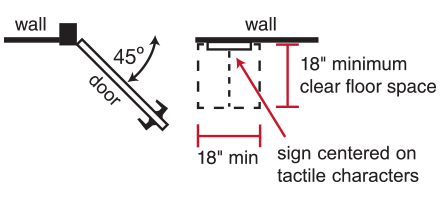
Signs containing tactile characters shall be located so that a clear floor space of 18 inches (457 mm) minimum by 18 inches (457 mm) minimum, centered on the tactile characters, is provided beyond the arc of any door swing between the closed position and 45 degree open position.
As shown below:
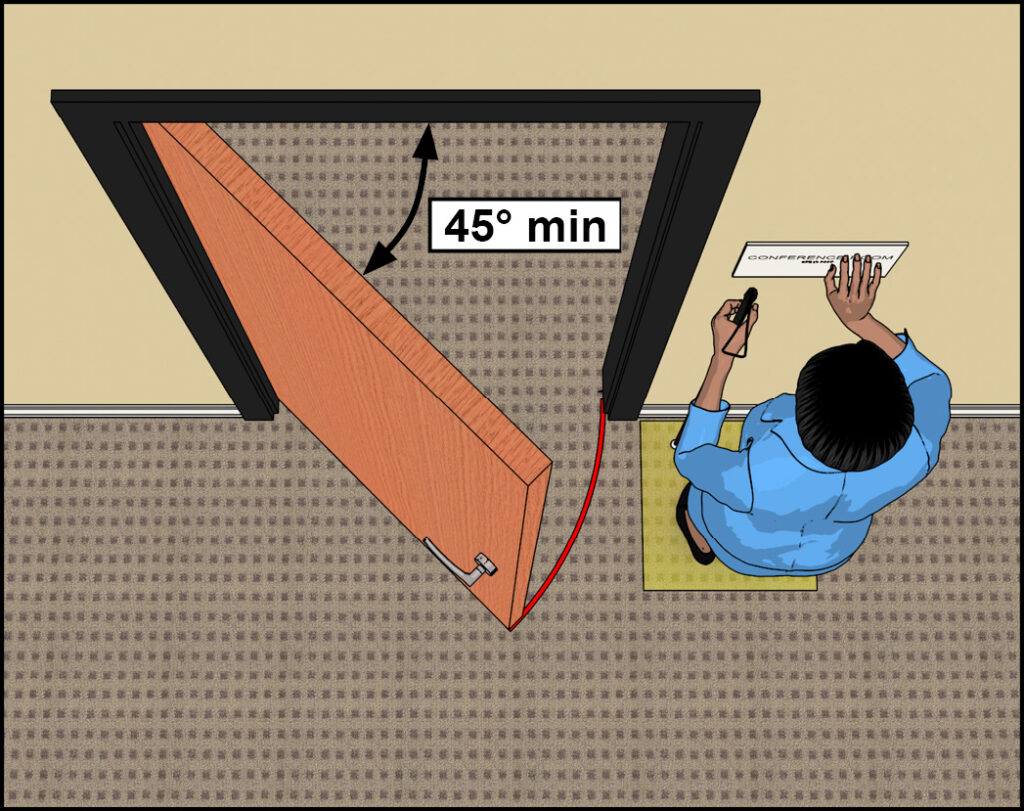
In fact, this area is also called the safety zone, which is to leave enough space for disabled people to ensure that when someone pushes out the door, the person who is touching the sign outside the door will not be hit by the door leaf:
This clear floor space must be beyond the swing of any door from a closed position to a 45° open position.
The picture above is a standard situation, but if the space on the latch side wall is not enough, then the space will have to be moved to the adjacent wall:
In this case, the distance between the Tactile Sign and the door frame is more than 9 inches.
FAQ
Do private residence restrooms also need to be ADA compliant?
No, private residence restrooms do not need to be ADA compliant, as the ADA only applies to public accommodations and commercial facilities.
Beyond California, do restroom signs only need to comply with the Federal 2010 ADA standards?
Generally speaking, yes, but it is always best to double-check local building codes during the actual project implementation.
Do restroom signs installed prior to the current standards need to be retrofitted to meet the latest requirements?
Generally, no. Under the Safe Harbor provision, existing signs that complied with the 1991 standards don’t need to be updated unless the facility undergoes an alteration. If the restroom is simply well-maintained and not being renovated, the old signs can remain as-is.
Take Away
The installation of Restroom ADA Signs seems simple, but in fact it is full of details, especially the installation height. You need to carefully study the standards to understand how to install it to avoid compliance risks.
I hope this article can help you master the installation details of restroom ADA signs more quickly, without having to dig through hundreds of pages of government standards documents.
While this guide focuses on restroom signs—the most common compliance challenge—the installation rules (height, offset, and placement) apply to almost all permanent room identification signs, including conference rooms, office rooms, etc.
As a veteran expert in this industry, FT Signage not only focuses on the products themselves but also closely monitors industry standards and developments. This is to accurately grasp the needs of our clients and provide them with tailored products and services.
Welcome to contact us to discuss your customization needs and explore further details.
Hi, this is Nicole Zhong. I have several positions.On the one hand, I am responsible for the sales of FT Signage. Starting in 2018, many friends and clients supported me and brought the signs industry to my life and I am extremely proud of what I am doing.On the other hand, I am writing down my years’ experience in the signage industry and sharing what I know for custom signs with all interested people.