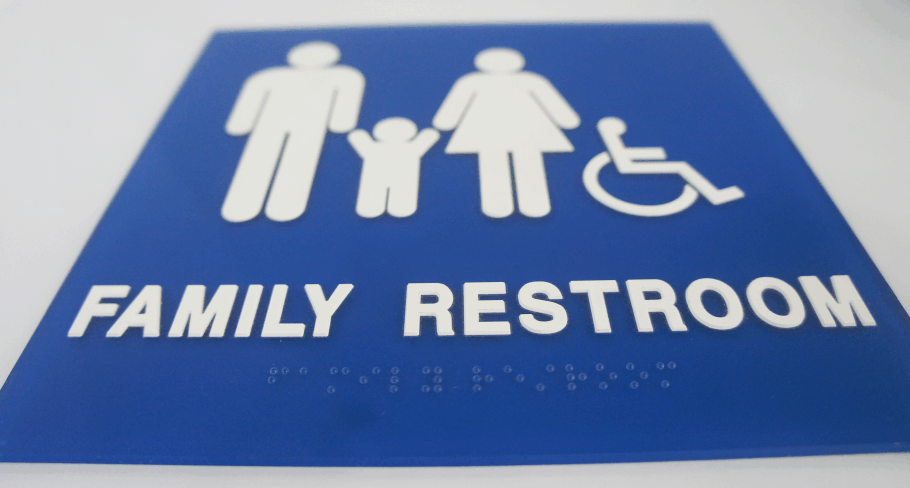
In the UK, whether a tactile & braille sign is properly hung is not determined by visual inspection, but by measuring it against the BS 8300-2 standard.
So how should we install it according to the BS 8300-2 standard?
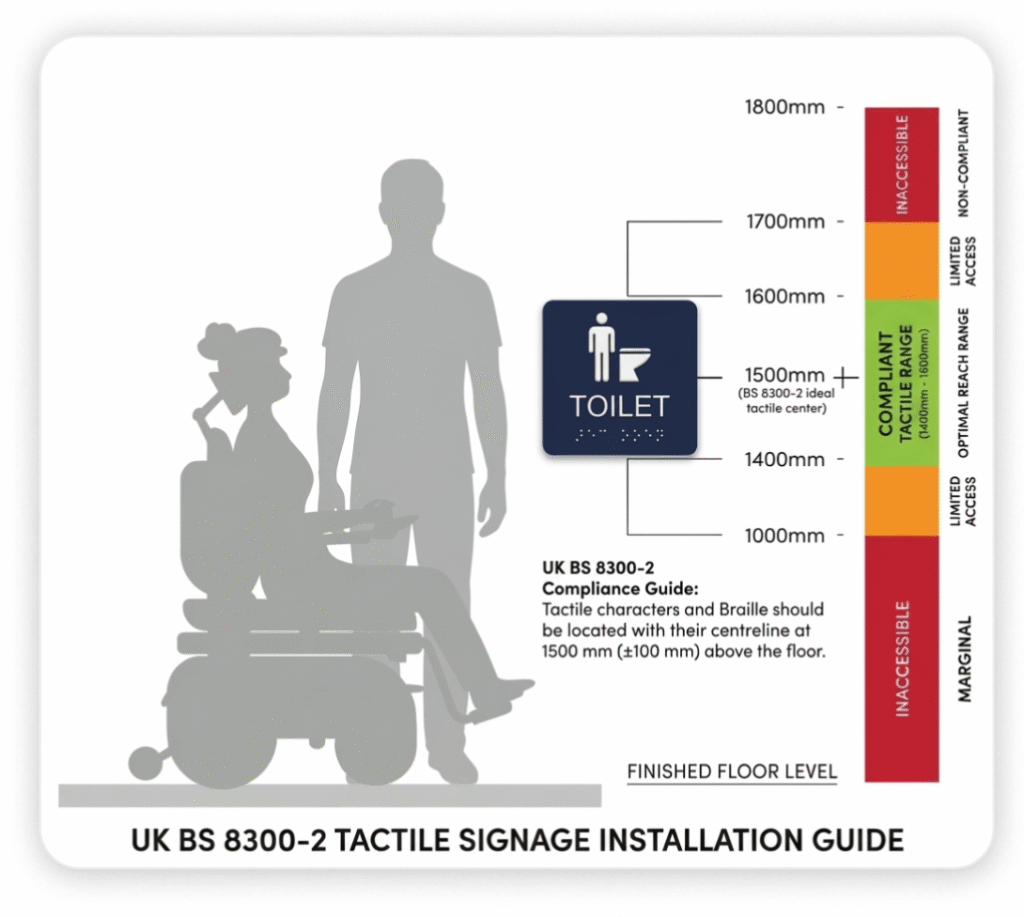
In short, wall-mounted tactile & braille signs should be installed on the door latch side, 100mm from the door frame, to ensure safety and predictability for visually impaired individuals. The installation height of the signs should be consistent, typically with characters 1500mm (±100mm) from the ground, so that information can be easily accessed by both standing and wheelchair people.
In fact, to properly install tactile and braille signs in the UK, two key points need to be considered: mounting heights and visual contrast.
Let’s discuss this in more detail.
Mounting Heights
According to the British standard BS 8300 published by the British Standards Institution (BSI), wall-mounted signs (general) in the UK must adhere to a certain installation height to ensure that people of different heights can easily read the signs (from BS 8300-2:2018, Paragraph 12 Signs and information):
Wall-mounted signs should be placed between 1400 mm and 1700 mm from finished floor level.
For tactile and braille signs, the height is more specific and clearly defined to ensure that both wheelchair users and standing users can easily reach them:
Tactile characters and Braille should be located with their centreline at 1500 mm (±100 mm) above the floor:
For suspended or projecting signs, there is also a height requirement to prevent the signs from hitting heads:
Signs suspended from the ceiling should provide a minimum headroom of 2300 mm.
To help you understand, I have created the following summary table:
| Sign Type | Placement | Height Requirement | Key Reference Point |
|---|---|---|---|
| Tactile & Braille Signs | Latch side, 50~100mm from door frame | 1500 mm (±100 mm) | Center line of the sign |
| Suspended or Projecting Signs | High Traffic Areas | 2300mm minimum | Bottom of the sign (Clearance) |
Visual Contrast
In BS 8300, in addition to requirements on the installation height of tactile and braille signs, in order to assist visually impaired users in quickly locating tactile information, there are also specific requirements for the visual contrast between the signage text and the signboard, and the visual contrast between the signboard and the wall (from BS 8300-2:2018, Paragraph 12 Signs and information):
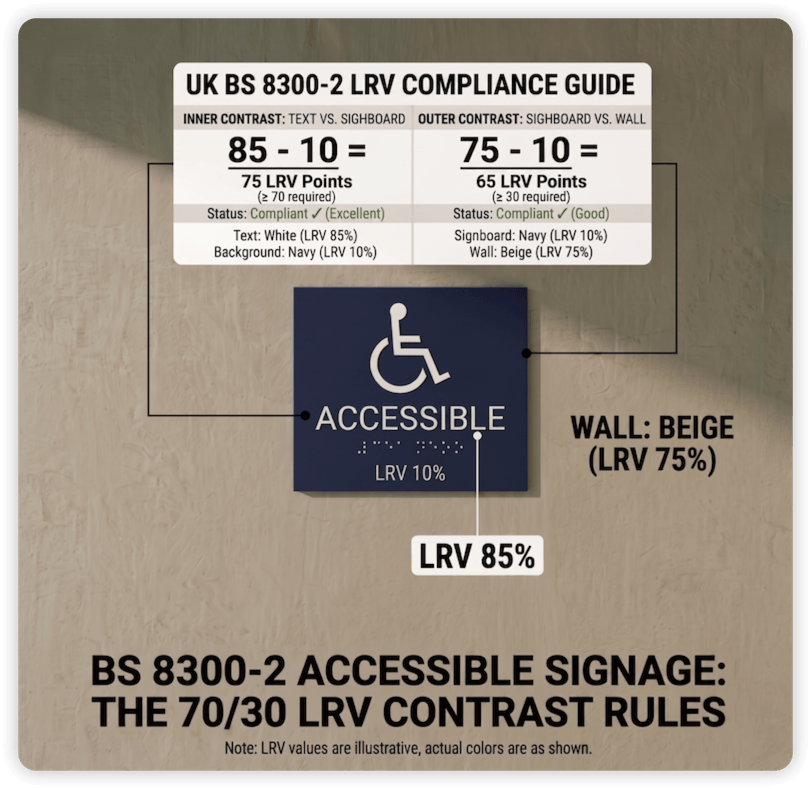
The two colours [of text/pictogram and background] should have a minimum difference in Light Reflectance Value (LRV) of 70 points.
The signboard should also visually contrast with the background it is mounted on by a minimum of 30 LRV points.
Important Note: The LRV requirements in BS 8300-2 are based on how colors are perceived under specific lighting conditions. When self-checking compliance, always consider the impact of both natural daylight and artificial LED lighting, as changes in illumination can significantly alter the visual contrast in the real world.
To help you understand, I have created the following example diagrams and tables:
| Element | Color | LRV Difference | Formula | Result |
|---|---|---|---|---|
| Inner Contrast | White on Navy | 85 vs 10 | 85 – 10 = 75 | Pass (≥ 70) |
| Outer Contrast | Navy on Beige | 10 vs 75 | 75 – 10 = 65 | Pass (≥ 30) |
Quick Reference: UK Tactile & Braille Standards
To ensure full compliance before installation, please note the following technical standards applied to your signs:
1. Font Style: All signage text should be in a sans serif font, start with an upper case letter and continue with lower case letters.
2. Font Heights (by viewing distance):
| Viewing Distance | Type of Sign | X-Height (Lower Case Letter) |
|---|---|---|
| Long Distance | Signs seen when approaching a building (e.g. building entrances) | 150mm min. |
| Medium Distance | Directional signs (e.g. identification signs in reception areas or directional signs in corridors) | 50mm to 100mm Note: the greater the reading distance the larger the letter required within this range |
| Short Distance | Room signs | 15mm to 25mm |
3. Embossed Characters: Tactile characters should be embossed between 0.8 mm and 1.5 mm above the background surface.
4. Braille Type: Braille should be contracted (Grade 2) unless the message is very short, positioned directly beneath the raised text(ensure the 6 mm exclusion zone), the braille size and spacing need to follow BS EN ISO 17049 braille standard:
Table 1 — Spacing between braille dots and cells in BS EN ISO 17049
| Parameters | Description | Distance Between Dot Centres(mm) |
|---|---|---|
| a | Vertical dot spacing (spacing between dot 1 and dot 2) | 2.2 to 2.8 |
| b | Horizontal dot spacing (spacing between dot 1 and dot 4) | 2.0 to 2.8 |
| p | Cell spacing (spacing between dot 1 and dot 1′) | 5.1 to 6.8 |
| q | Line spacing (spacing between dot 1 and dot 1″) | 10.0 to 15.0 |
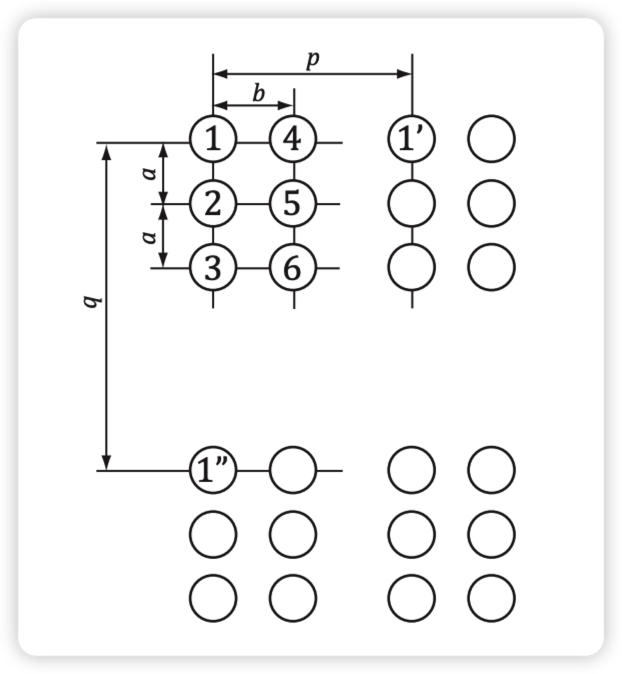
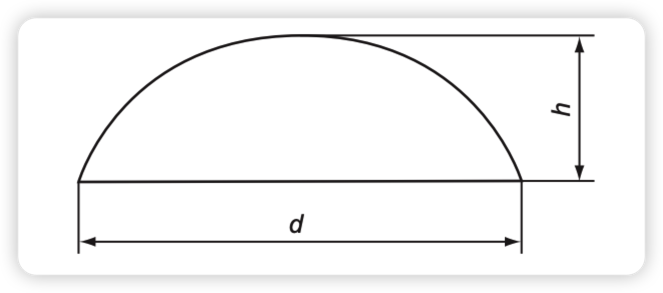
Table 2 — Dimensions of cross-section of a braille dot in BS EN ISO 17049
| Parameter | Description | Size(mm) |
|---|---|---|
| d | Diameter of the base | 1.0 to 1.7 |
| h | Perpendicular height of braille dot centre | 0.3 to 0.7 |
5. Based on industry best practices, here are the most reliable material options:
- Laser-Engraved Acrylic: Cost-effective, wipe-clean, and provides crisp tactile edges.
- Photopolymer: High-durability and superior tactility for high-traffic environments.
- Etched Metal with Infill: Premium and long-lasting; must use matte finishes to avoid glare.
- Pro Tip: Use a compliant backplate to pair brand colors with required LRV contrast.
FAQ
What is the BS 8300?
BS 8300(British Standard 8300) is a British Code of Practice that sets out the requirements of how buildings should be designed, constructed and maintained to meet the needs of disabled people as well as create an accessible and inclusive environment for them.
What is BS 8300-2:2018?
BS 8300 defines the best practices for designing an accessible and inclusive environment.
There are two parts:
- BS 8300-1 — for external environments e.g. car parks and access routes.
- BS 8300-2 — for buildings e.g. internal layout and facilities.
BS 8300-1 and BS 8300-2 were published in 2018, they replaced BS 8300:2009.
What is the latest version of BS 8300?
BS 8300-1:2018, BS 8300-2:2018 are the latest version of BS 8300 until now in UK.
What are DDA signs in the UK?
DDA stands for Disability Discrimination Act.
Although the term ‘DDA signs’ is still widely used in the industry, the Disability Discrimination Act was officially replaced by the Equality Act 2010 on October 1, 2010. Today, technical compliance for signage in UK is BS 8300-2:2018.
Does every room in a public building require braille signage?
Not every room, but all functional spaces and essential facilities must have them. This includes toilets, changing rooms, lifts, and meeting rooms.
Why is LRV contrast important for accessible signage?
High LRV contrast ensures individuals with visual impairments can clearly distinguish characters from the signboard and the sign from the wall.
Take Away
To ensure your signage is fully compliant with UK accessibility standards, keep these four critical points in mind:
- Location: Mount signs on the latch side (handle side) of the door, never on the door itself.
- Height: Position general wall-mounted signs between 1400mm and 1700mm above the floor. For tactile and Braille signs, a height of 1500mm (±100mm) is required to assist visually impaired users.
- Contrast: Aim for 70/30 LRV contrast (70+ for text/sign, 30+ for sign/wall); check visibility under real LED/daylight.
- Braille Specifications: Adhere to the BS EN ISO 17049 standard for precise dot spacing and sizing. Importantly, maintain a 6mm exclusion zone around all Braille cells to prevent tactile interference.
As a veteran expert in this industry, FT Signage not only focuses on the products themselves but also closely monitors industry standards and developments. This is to accurately grasp the needs of our clients and provide them with tailored products and services.
Welcome to contact us to discuss your customization needs and explore further details.
References:
BS 8300-2:2018 Design of an accessible and inclusive built environment. Part 2: Buildings — Code of practice
ISO 17049:2013 – Accessible design — Application of braille on signage, equipment and appliances