When designing braille signs, we often encounter a problem:
How far should the braille be from the raised text?
In fact, the accessibility standards in the United States and Canada have already made provisions for this matter, and they have introduced an important concept – Exclusion Zone.
This article will explain the meaning of “Exclusion Zone” and the requirements of relevant standards in the United States and Canada.
What Is the Braille Exclusion Zone?
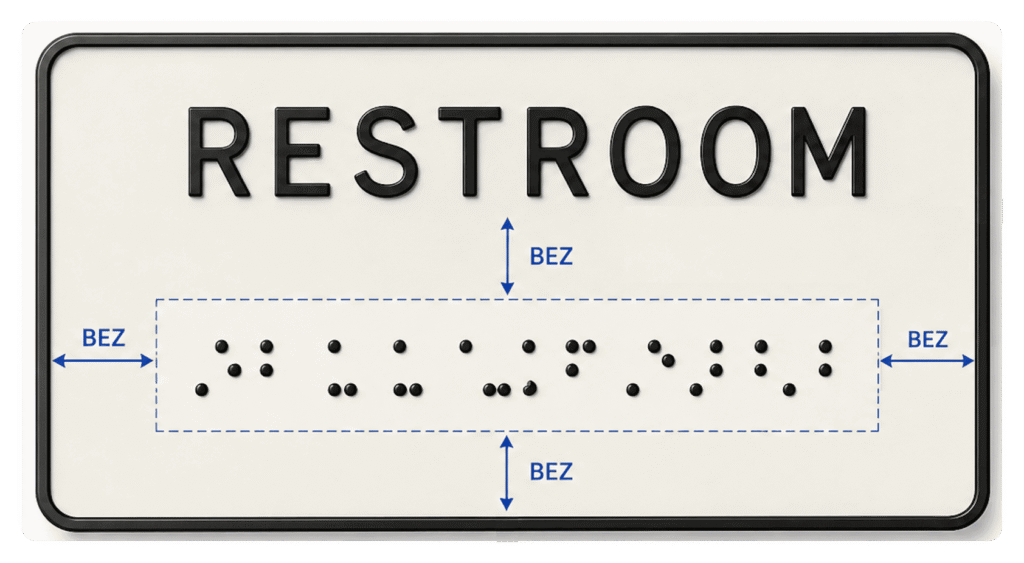
When designing Braille signs, if the distance between Braille characters and raised text, raised patterns or borders is too close, it may interfere with tactile reading recognition. To ensure the readability of Braille, accessibility sign standards usually require a certain blank area to be reserved between Braille and the surrounding raised elements, so as to clearly distinguish Braille, text, patterns and borders. This reserved space is called the Braille Exclusion Zone, as shown in the following figure:
What Are The Exclusion Zone Requirements in the U.S. and Canada?
In order to standardize the clearance between braille and raised characters, patterns, and borders, and to ensure the readability of braille signs, both Canada and the United States have made explicit regulations regarding the Exclusion Zone.
In The U.S.
According to Section 703.3.2 Position of the Federal Standard “2010 ADA Standards for Accessible Design”, the following regulations have been made:
Braille shall be separated 3/8 inch (9.5 mm) minimum from any other tactile characters and 3/8 inch (9.5 mm) minimum from raised borders and decorative elements.
The regulations of the Exclusion Zone in California are even more stringent than those of the federal government. It not only sets a minimum value but also a maximum value. In the “2025 California Building Code”, 11B-703.3.2 Position, the following provisions are made:
Braille shall be separated ⅜ inch (9.5 mm) minimum and ½ inch (12.7 mm) maximum from any other tactile characters and ⅜ inch (9.5 mm) minimum from raised borders and decorative elements.
In addition, both the federal standards and the California standards have specified requirements for the clearance between characters and raised borders as well as decorative elements:
“2010 ADA Standards for Accessible Design”, 703.2.7 Character Spacing.—Characters shall be separated from raised borders and decorative elements 3/8 inch (9.5 mm) minimum.
“2025 California Building Code”, 11B-703.2.7 Character spacing.—Characters shall be separated from raised borders and decorative elements ⅜ inch (9.5 mm) minimum.
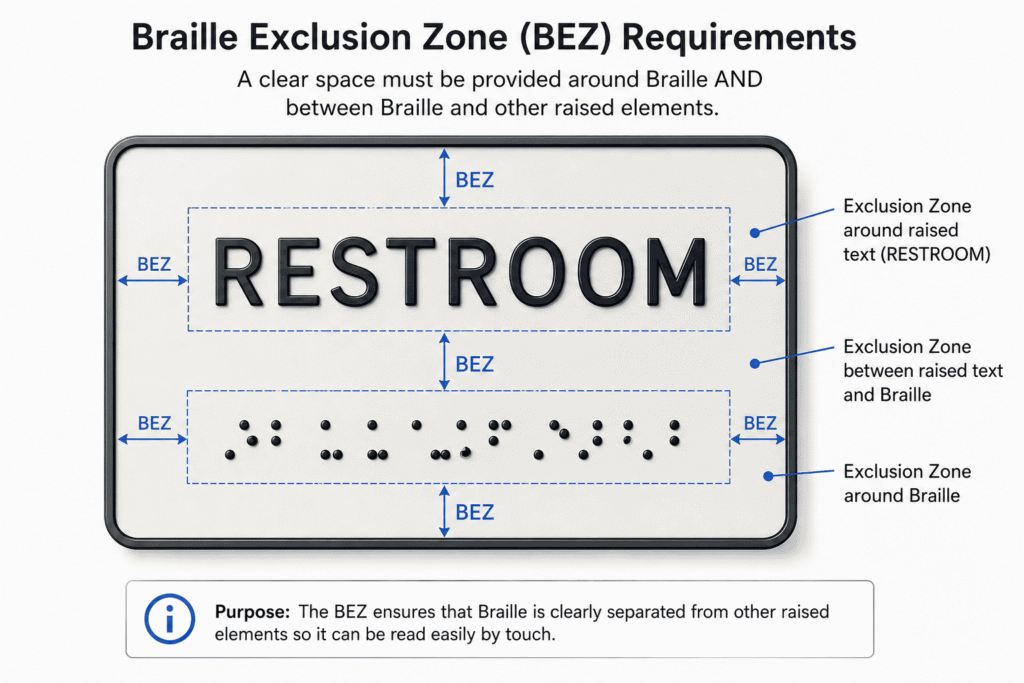
Summarizing the requirements of the US federal government and the state of California for the Exclusion Zone, if you design according to the diagram shown below, you can meet both the federal and California requirements:
In Canada
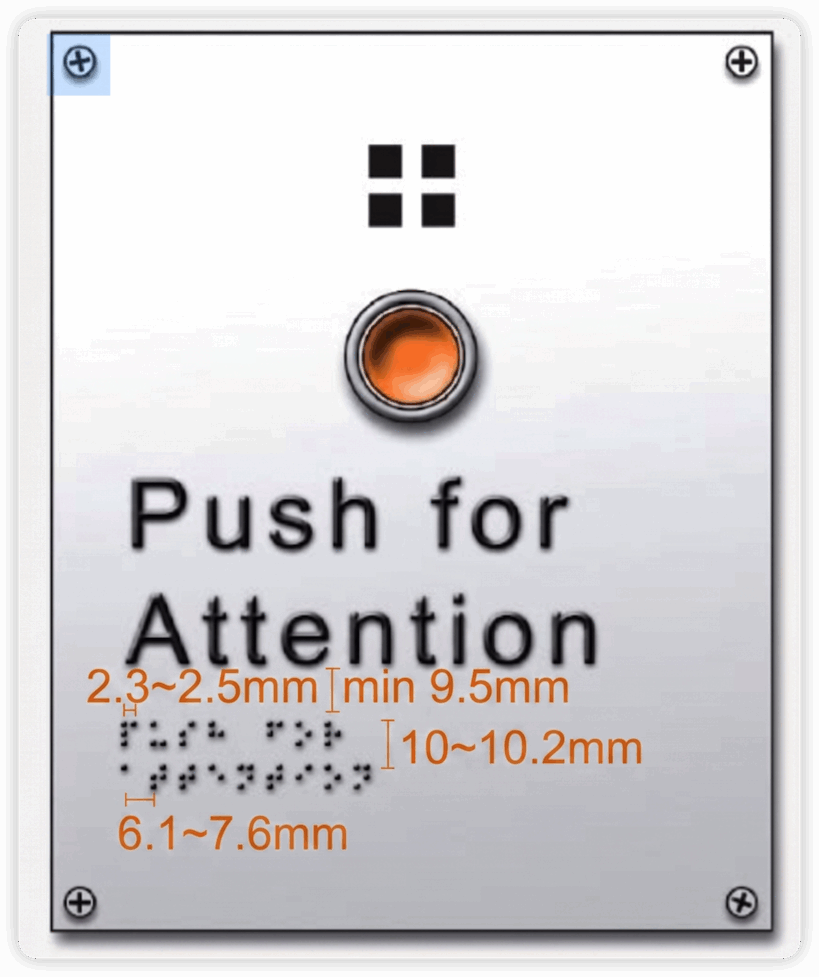
Canada’s requirements for Braille Exclusion Zones are the same as those of the United States. In CAN-ASC-2.4 – Wayfinding and Signage, 12.8.1 Braille dots, it is described as follows:
Braille shall be separated by a minimum of 9.5 mm from any other tactile characters and 9.5 mm from raised borders and decorative elements.
As shown in the figure below:
FAQ
Is the Braille Exclusion Zone the same in the U.S. and Canada?
Not exactly. In the U.S., the federal standard requires both a Braille Exclusion Zone and a separate clear space for raised characters. California is even more specific, adding a maximum value for the Braille Exclusion Zone. In Canada, the standard sets a minimum clear space for Braille, but does not include a separate requirement for the characters’ exclusion zone.
What happens if the Braille is placed too close to raised text or borders?
It can reduce readability and make the tactile information harder to distinguish, which may cause the sign to fail accessibility expectations.
Is the Braille Exclusion Zone a recommendation or a requirement?
It is a requirement under accessibility standards, not just a design suggestion.
Take Away
The Braille Exclusion Zone is a critical design detail that ensures braille signs remain readable and compliant. In both the U.S. and Canada, accessibility standards require sufficient clearance between braille, raised text, decorative elements, and borders so that tactile information can be clearly distinguished. When designing braille signs, following these spacing rules is essential not only for compliance, but also for creating signage that is truly usable for people with visual impairments.
If you are planning a braille sign project, reach out to us for expert support.
References: