

As early as the 1970s, Samuel Genensky, who himself had severe vision impairment, began to dedicate himself to making it easier for visually impaired people to find restrooms. Based on his own experience (he had no sight in his left eye and only 20/1000 vision in his right eye after a medical accident when he was a newborn), he hoped to use large geometric symbols that people with low vision could identify better.
Samuel Genensky’s efforts eventually paid off, and California began marking women’s restrooms with a 12-inch circle and men’s restrooms with a 12-inch equilateral triangle:
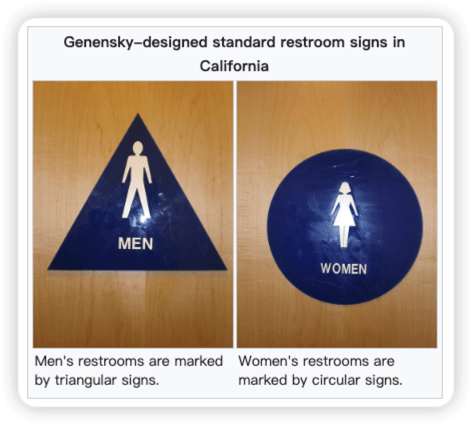
The U.S. federal ADA Act was not signed until 1990, and the technical guidance ADAAG was not issued until a year later in 1991.
This leads to a problem:
Should California abandon its own restroom geometric signs, which have been in use for over a decade, and directly adopt the federal ADA standard?
Finally, California decided to keep their guidelines and adopt federal ADA signage laws at the same time.
Therefore, a major difference between federal and California restroom ADA signs is that California uses large geometric symbols on restroom doors, while federal standards do not. Additionally, California has stricter requirements regarding Braille spacing and the installation height of ADA signs.
However, simply knowing these differences is far from enough. To avoid trouble, we also need to understand the detailed differences between them, which I will explain one by one below.
Signage Composition
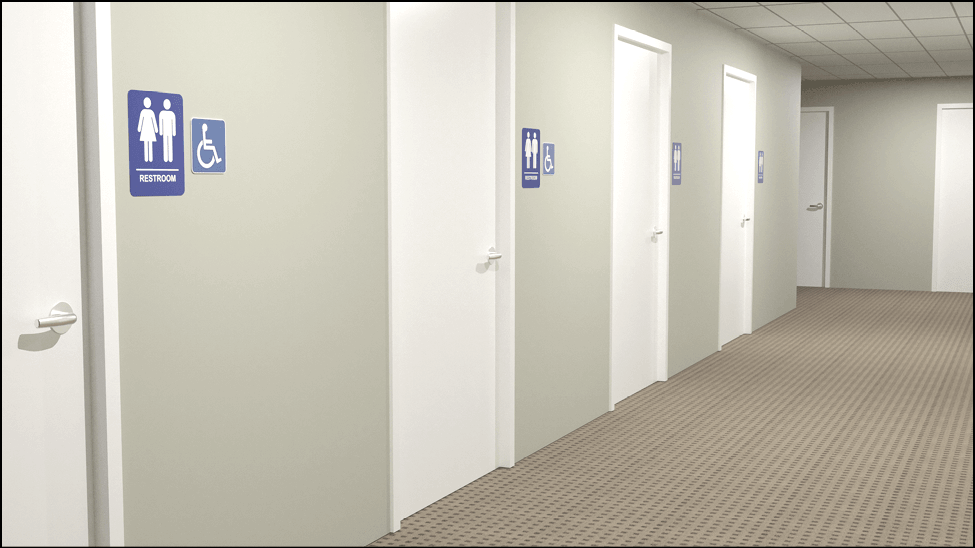
Federal 2010 ADA (National Standard) only requires wall-mounted tactile sign, as shown in the image below:
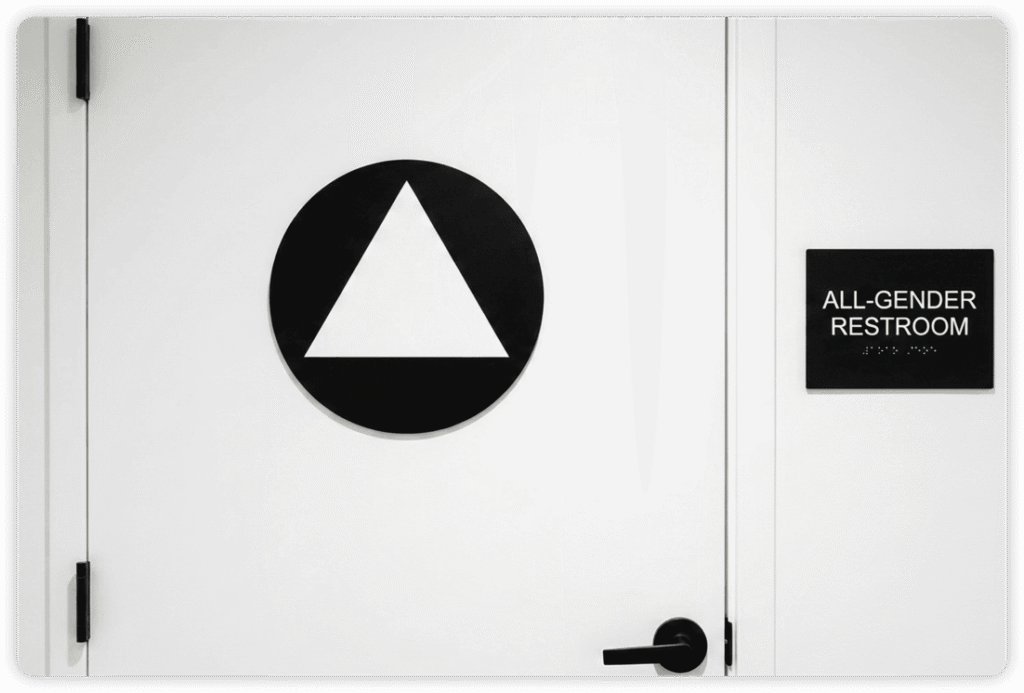
California Title 24 requires not only a tactile sign to be hung on the wall, but also a geometric symbol to be hung on the door, as shown in the image below:
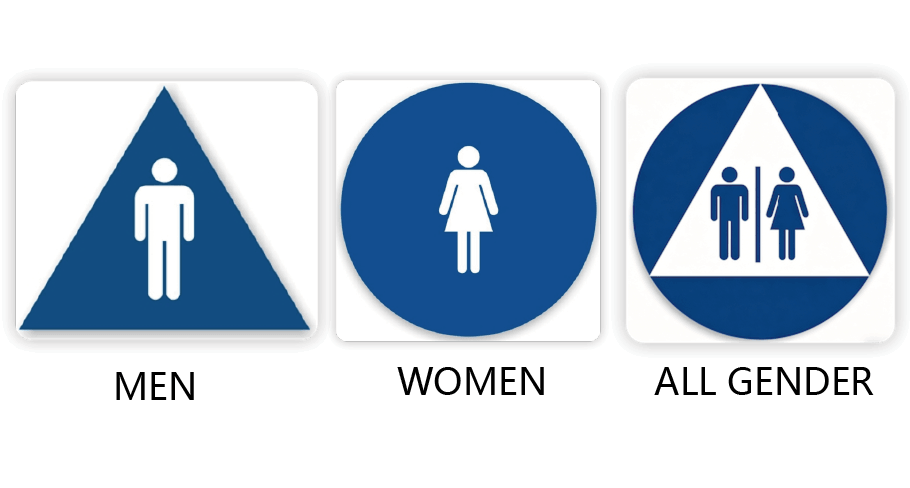
There are three main restroom geometric symbol types in California: the first is male, which is an equilateral triangle; the second is female, which is a circle; and the third is neutral, which is a circle with a triangle inside.
As shown in the image below:
Braille Standard
The 2010 Federal ADA Standards require Grade 2 Braille, specifying a certain range for dot and cell spacing. California, however, has even stricter requirements for these measurements.
I have summarized the differences between them in a table, as shown below:
| Measurement Range | Federal 2010 ADA(inch) | California Title 24(inch) |
|---|---|---|
| Dot base diameter | 0.059 (1.5 mm) to 0.063 (1.6 mm) | same as Federal |
| Distance between two dots in the same cell | 0.090 (2.3 mm) to 0.100 (2.5 mm) | 0.100 (2.5 mm) |
| Distance between corresponding dots in adjacent cells | 0.241 (6.1 mm) to 0.300 (7.6 mm) | 0.300 (7.6 mm) |
| Dot height | 0.025 (0.6 mm) to 0.037 (0.9 mm) | same as Federal |
| Distance between corresponding dots from one cell directly below | 0.395 (10 mm) to 0.400 (10.2 mm) | same as Federal |
For a detailed comparison of the Braille standards between the Federal 2010 ADA (National Standard) and California Title 24 (California Standard), please refer to this article:
What’s the Difference between Federal Braille Signs and California Braille Signs?
Installation Height
Wall-mounted Tactile Signs Height
There are significant differences between the Federal 2010 ADA (National Standard) and California Title 24 (California Standard) regarding the installation height requirements for wall-mounted Tactile Signs.
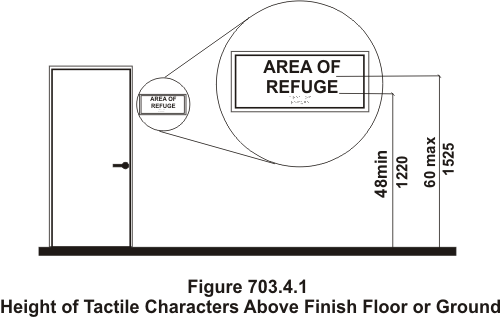
The Federal 2010 ADA (National Standard) requires the following installation height for wall-mounted tactile signs (excerpted from 2010 ADA Standard, 703.4.1 Height Above Finish Floor or Ground):
Tactile characters on signs shall be located 48 inches (1220 mm) minimum above the finish floor or ground surface, measured from the baseline of the lowest tactile character and 60 inches (1525 mm) maximum above the finish floor or ground surface, measured from the baseline of the highest tactile character.
The diagram is as follows:
California Title 24 (California Standard) specifies the following installation height requirements for wall-mounted tactile signs (excerpted from 2025 California Building Code (CBC), 11B-703.4.1 Height above finish floor or ground):
Tactile characters on signs shall be located 48 inches(1219 mm) minimum above the finish floor or ground surface, measured from the baseline of the lowest Braille cells and 60 inches (1524 mm) maximum above the finish floor or ground surface, measured from the baseline of the highest line of raised characters.
The diagram is as follows:
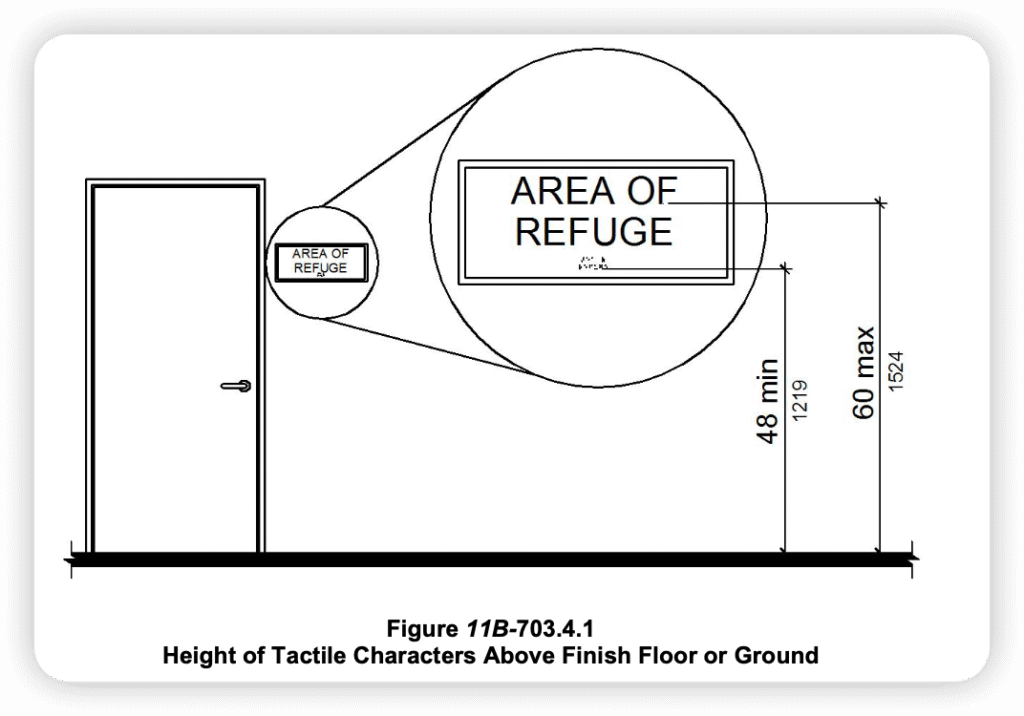
The most fundamental difference between them lies in the measurement of the minimum installation height for wall-mounted tactile signs. The Federal 2010 ADA (National Standard) measures it from the baseline of the lowest Tactile character, while the California Title 24 (California Standard) measures it from the baseline of the lowest Braille cells.
However, even with this distinction, following California Title 24 (California Standard) can still simultaneously meet Federal 2010 ADA (National Standard). Practitioners in California do not need to make any special adjustments; they can simply follow the California Standard.
Geometric Symbols Height
Regarding the installation height requirements for geometric symbols on doors, since the Federal 2010 ADA (National Standard) does not mandate their installation, there are no specific requirements for the installation height.
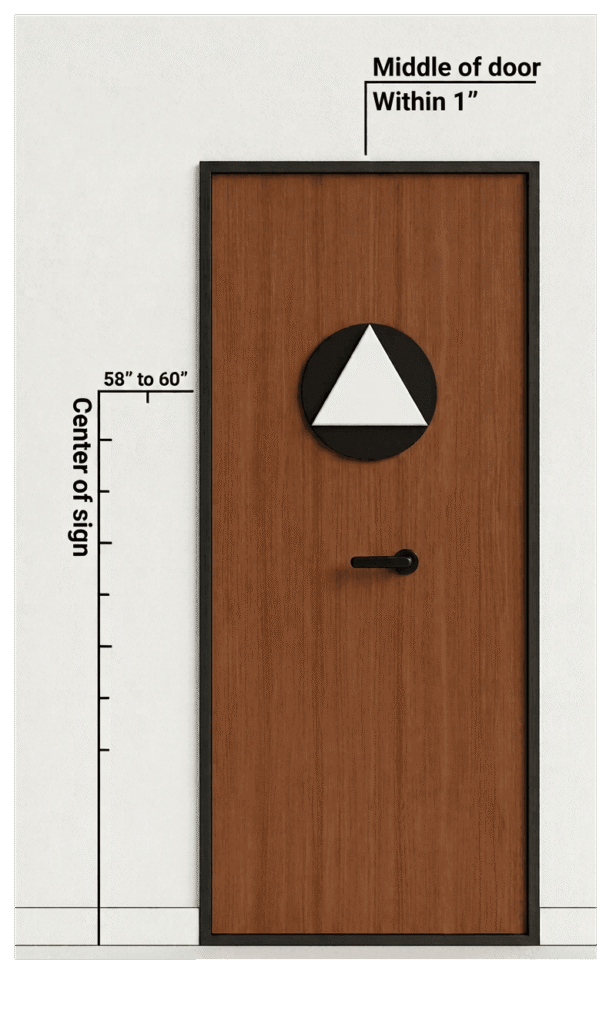
But California Title 24 (California Standard) specifies the following requirements regarding the installation height of geometric symbols on doors (excerpted from 2025 California Building Code (CBC), 11B-703.7.2.6 Toilet and bathing facilities geometric symbols):
Geometric symbols at entrances to toilet and bathing rooms shall be mounted at 58 inches (1473 mm) minimum and 60 inches (1524 mm) maximum above the finish floor or ground surface measured from the centerline of the symbol. Where a door is provided the symbol shall be mounted within 1 inch (25 mm) of the vertical centerline of the door.
The diagram is as follows:
Take Away
Despite these significant differences between federal and California standards, there’s no need to panic; the compliance principle is actually quite simple:
Follow California Title 24 in California, and follow the 2010 ADA Standard outside of California.
But please note: In addition to the federal ADA standards, some states outside of California (such as New York or Texas) may have their own specific requirements. It is always best to double-check local building codes during the actual project implementation.
As a veteran expert in this industry, FT Signage not only focuses on the products themselves but also closely monitors industry standards and developments. This is to accurately grasp the needs of our clients and provide them with tailored products and services.
Welcome to contact us to discuss your customization needs and explore further details.
References: