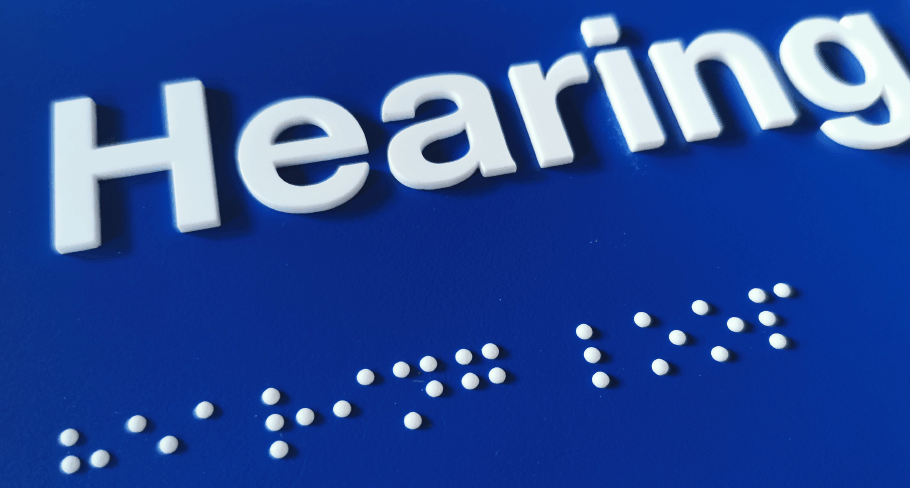
In the world of the blind, Braille is their only form of writing. According to data from the World Health Organization (WHO) in 2019, approximately 2.2 billion people worldwide suffer from some form of visual impairment.
Because English is the most widely spoken language in the world, English Braille is also the most widely used Braille system in the world.
The full name of English Braille is Unified English Braille, abbreviated as UEB, which is divided into Grade 1 Braille and Grade 2 Braille.
In short, the main difference between Grade 1 Braille and Grade 2 Braille is whether or not contractions are used. Grade 1 Braille does not use contractions, each letter or character corresponds to a complete Braille symbol, which takes up a lot of space, has a low learning curve, and is suitable for beginners. Grade 2 Braille, on the other hand, uses contractions. For example, common combinations such as “-ing”, “-ed”, and “-tion” have special abbreviation symbols, which greatly reduces the space required. It is suitable for experienced readers and can significantly improve reading efficiency. Currently, most publications (such as books and magazines) use Grade 2 Braille.
What is Braille?
By definition, Braille is a tactile reading and writing system for the blind or visually impaired. It uses raised dots to read by touch. Each set of dots represents a letter, word, number, or punctuation mark. The system was invented by Louis Braille in the early 19th century and is printed on paper or embossed on cardboard.
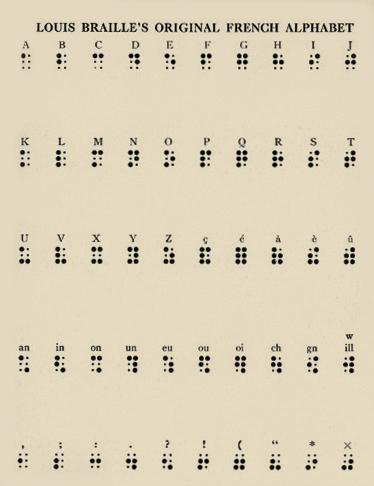
Grade 1 Braille: Uncontracted Braille
Grade 1 Braille is the most basic system, using a letter-for-letter transcribing method.
Its core feature is that each letter or character corresponds to a complete Braille symbol, without any abbreviations or shortened forms.
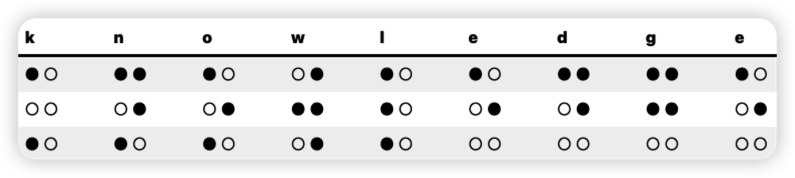
The advantages of Grade 1 Braille are its low learning curve, extreme precision, and lack of ambiguity; however, its disadvantages are also obvious: it takes up a lot of space and is relatively slow to read. For example, the English word “knowledge” requires 9 Braille cells in Grade 1 Braille.
Although Grade 1 Braille takes up a lot of space, it still has a wide range of applications, such as beginner textbooks, labels, menus, and proper nouns that require precise spelling, such as names of people and places.
Grade 2 Braille: Contracted Braille
Grade 2 Braille is currently the most commonly used Contracted Braille internationally.
Its core feature is the introduction of a large number of contractions and shortforms. For example, in English grade 2 Braille, the letter b alone can mean “but” and the letter c means “can”. There are also abbreviations for word roots or suffixes, such as “-ing”, “-ed”, “-tion” and other common combinations, which have special simplified symbols.
Grade 2 Braille significantly reduces document size (typically by 20% to 25%), improving reading efficiency for experienced readers; however, its drawbacks include complex rules, a steep learning curve, and the fact that a symbol may have different meanings in different contexts.
Currently, the vast majority of publications (books, magazines), public signs in some countries (such as ADA signs in the United States), and everyday writing use Grade 2 Braille.
Grade 1 vs. Grade 2 Braille Differences Summary
To help you understand, let’s take the English word “knowledge” as an example.
Grade 1 Braille looks like this:
Grade 2 Braille looks like this:
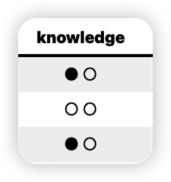
The table below shows the differences between Grade 1 Braille and Grade 2 Braille:
| Feature | Grade 1 Braille (Uncontracted) | Grade 2 Braille (Contracted) |
|---|---|---|
| Transcription Principle | Letter-for-Letter: Every printed letter is represented by a single Braille cell. | Abbreviation & Shortform: Uses specific signs to represent whole words, prefixes, or suffixes. |
| Word Example | The word “Knowledge” requires 9 cells (k-n-o-w-l-e-d-g-e). | The word “Knowledge” is represented by just 1 cell (the letter ‘k’). |
| Space Efficiency | High Space Consumption: Takes up the most physical space on a sign or page. | Space Saving: Reduces the length of text by approximately 20% to 25%. |
| Learning Curve | Basic: Requires only the knowledge of the 26 alphabet signs. | Advanced: Requires learning hundreds of contraction rules and context-specific meanings. |
| Reading Speed | Slower, as the reader must scan every individual letter. | Faster for proficient readers, as it allows for quicker word recognition. |
| Precision | Highest: Zero ambiguity; ideal for spelling names, technical terms, or medications. | High: Extremely efficient, though requires context to interpret certain symbols. |
| Common Use Cases | Beginners’ books, labels, menus, and short identifiers like room numbers. | Industry Standard: Used for books, magazines, and public ADA/BS 8300 signage. |
Global Stipulations: How Countries Decide
Although Grade 2 Braille can save a lot of space, not every country uses Grade 2 Braille, especially in the field of Braille signage. Some countries use Grade 1 Braille, some use Grade 2 Braille, and some use a combination of Grade 1 and Grade 2 Braille.
USA
In the United States, according to the U.S. federal 2010 ADA standard, the braille for signage shall be contracted, that is, Grade 2 Braille shall be used.
In addition, the United States has relatively detailed regulations regarding Braille dot height, cell spacing, and installation, and these regulations are even stricter in California. Please refer to these two articles for details:
3 Key Differences Between Federal and California Restroom ADA Signs
How to Install ADA Compliant Restroom and Room Signs?
Canada
Canada, on the other hand, has taken into account the needs of both beginner and advanced Braille users, and has introduced The 10-Word Rule for signage:
Uncontracted braille shall be used for signs that have 10 words or less, and contracted braille for signs with more than 10 words.
Furthermore, Canada has completely different regulations from the United States regarding Braille dot height, cell spacing, and Braille sign installation. Please refer to this article for details:
Ordering Tactile Braille Signs in Canada: An AODA & CSA B651 Compliance Guide
UK & Ireland
In the UK, according to BS 8300-2 and BS EN ISO 17049 standards, Braille for signs should be contracted (Grade 2) unless the message is very short, and a 6 mm exclusion zone must be left on the Braille sign. Please refer to this article for details.
BS 8300-2 Guide: Installing Tactile & Braille (DDA) Signage in UK
In neighboring Ireland, the standards for Braille are almost identical to those in the UK, but according to its Official Languages Act, signs often need to be bilingual in English and Irish.
Australia & New Zealand
In Australia, Grade 1 Braille is required for all Braille signs. This results in multiple lines of Braille on Australian Braille signs, necessitating the addition of Braille indicators to help locate the first line of Braille. For details, please refer to this article:
Ordering Tactile and Braille Signs for Australia: NCC & AS 1428.1 Guide
New Zealand, a neighbor not far from Australia, has almost the same Braille standards as Australia, uniformly following ABA(Australian Braille Authority).
Europe
The situation in Europe is more complex because there are many countries and a wide variety of languages. There doesn’t seem to be a unified standard, and Braille signs should be customized according to the specific circumstances of each country.
However, Germany and Italy seem to have different requirements regarding Braille dot height, cell spacing, and other specifications. They prefer to use the Marburg Large Braille rather than the more commonly used Marburg Medium Braille in Europe to ensure higher legibility. Please refer to this article for details:
How to Install Tactile Braille Signs in Europe?
FAQ
Is there such a thing as Grade 3 Braille?
Yes, Grade 3 Braille does exist, but it has not been standardized. Grade 3 Braille can be considered the “shorthand” of Braille, but due to its complexity and lack of a unified official standard, it is rarely used in publications and is not included in the common settings of modern Braille aids such as Braille displays.
Can Grade 1 and Grade 2 Braille be used on the same sign?
Generally, it is best practice to maintain consistency across a single sign or project to avoid confusing the reader. However, some standards, like the Canadian 10-Word Rule, may lead to a mix of grades within the same facility (Grade 1 for short room names and Grade 2 for long directions). If a mix is unavoidable, ensure there is a clear logical separation. We recommend consulting your local accessibility inspector to ensure that a mixed-grade layout won’t lead to a compliance failure.
If my sign has both English and another language, which Braille grade should I use?
This depends on the specific language’s Braille system. For the English portion, you would typically follow the destination country’s rule (e.g., Grade 2 for the UK). For the second language (like Irish or Spanish), it must follow its own specific Braille coding rules. In such cases, the key is to ensure sufficient clear space between the two Braille blocks so a reader doesn’t accidentally slide their finger from one language into the other.
Should the visual raised text always match the Braille grade?
Not necessarily. While the visual text is always “uncontracted” (spelled out letter-for-letter), the Braille below it can be Grade 2 (contracted) to save space. The most important factor is ensuring the Braille follows the specific accessibility mandate of the local country.
Take Away
While there is a general logic to Braille grading, different countries have very specific legal requirements regarding the choice of grade and layout. When ordering Braille signs for your projects, do not assume Grade 2 is universal. For instance, applying US-style Grade 2 rules to a project in Australia would result in a compliance failure, as they strictly require Grade 1.
Therefore, for each project, we advise clients to confirm the latest local regulations and requirements before placing an order.
At FT Signage, we focus on the technical precision of every tactile element. Whether your project requires Grade 1 Braille for a facility in Sydney or Grade 2 contractions for a building in California, we are here to manufacture signs that strictly follow your requirements.
Accuracy in Braille is about more than just dots, it’s about accessibility and safety. We are committed to working through these technical details with you to ensure the final product meets your expectations. Feel free to contact us to discuss your specific project needs.
References:
2010 ADA Standards for Accessible Design
CAN-ASC-2.4 – Wayfinding and Signage
Australian Braille Authority: Physical Specifications for Braille