
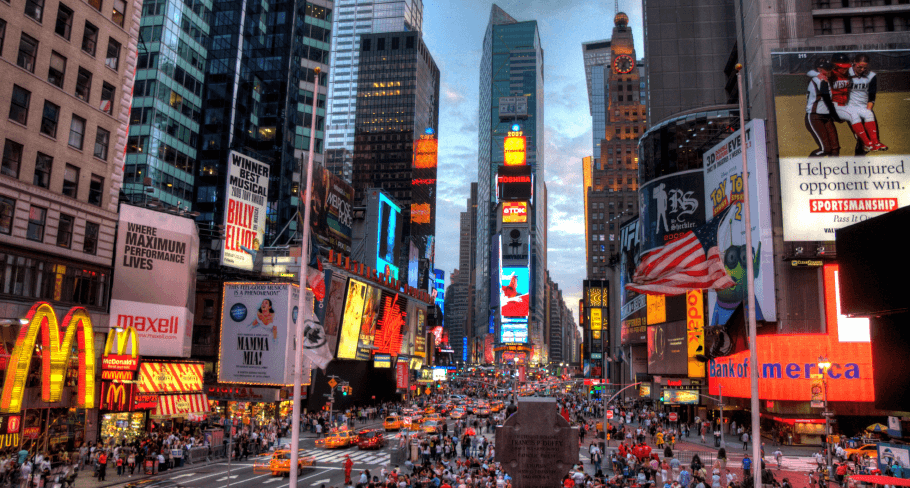
Walking on the street, you can see signs almost everywhere. Whether it’s the storefront signs, the mall directions, or the various indication systems in office buildings, hospitals, airports, signs have already permeated every corner of the urban commercial space. That is why the signage industry has always been a large-scale, stable-demand and continuously-evolving market.
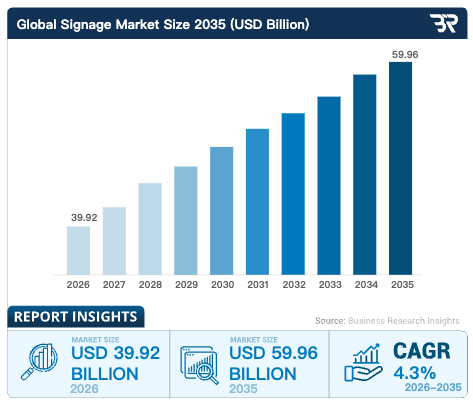
According to a report by Business Research Insights, the global signage market is projected to reach 39.92 billion US dollars by 2026 and is expected to grow to 59.96 billion US dollars by 2035, with a compound annual growth rate of 4.3% from 2026 to 2035. This indicates that although the signage industry is not an explosively growing sector, it is still continuously expanding and maintaining steady development driven by commercial activities, technological upgrades, and space renovations.
How the Signage Market is Segmented?
If one wants to truly understand the signage industry, one cannot merely focus on its “size”, but also needs to consider what it is composed of. From the perspective of the industry structure, the signage market can be roughly divided into two categories: traditional signage and digital signage.
Traditional Signage
Traditional signage include billboards, banners, posters, static signage systems, and various physical signs. For decades, they have been widely used in advertising campaigns, brand promotion, and space guidance scenarios. For many enterprises, traditional signs remain the most direct, stable, and cost-effective way to expose their brand, especially in outdoor areas, high-traffic zones, and long-term fixed display scenarios.
Although digital solutions are becoming increasingly widespread, traditional signs still hold a dominant position in the market due to their advantages such as durability, intuitiveness, and relatively mature production cycle. For a large number of small and medium-sized enterprises, stores, and project-oriented clients, it remains the most practical choice.
Digital Signage
Digital signage includes LED screens, interactive displays, tiled screens, intelligent digital screens, etc. The greatest advantage of this type of product lies in the fact that the content can be updated in real time and it has stronger interactive capabilities and visual impact. More and more enterprises are using digital signage for dynamic advertising, information dissemination and customer interaction to enhance communication efficiency and brand experience.
Digital signage is particularly suitable for scenarios such as retail stores, transportation hubs, hotels, corporate office buildings, and commercial complexes. With the continuous improvement of content management systems, cloud technology, and network connectivity capabilities, digital signage is gradually evolving from a “high-end optional feature” to a standard configuration in more and more scenarios.
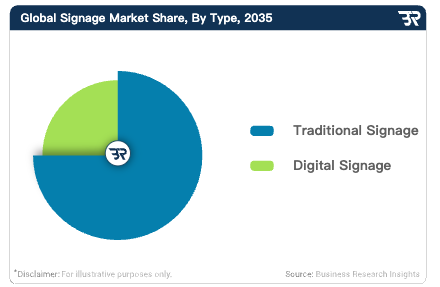
From the perspective of industry structure, digital signage currently only accounts for a small portion of the signage market, approximately 25%, but its growth rate is significantly faster than that of traditional signage, making it the most noteworthy growth sector at present.
Signage Application Scenarios
In addition to being classified by type, the signage market can also be divided into indoor signage and outdoor signage based on the usage scenarios. This dimension is different from “traditional/digital”, as it places greater emphasis on the functions and demand logic of signage in different spaces.
Indoor Signage
Indoor signage are widely found in retail stores, shopping malls, hospitals, office buildings and hotels, etc. Their main functions include wayfinding, information dissemination, brand display and customer guidance. In retail settings, digital displays and interactive terminals can help businesses enhance the shopping experience and drive sales through promotional information and personalized recommendations.
In medical institutions and corporate environments, indoor signs serve various functions such as announcement dissemination, route guidance, information updates, and employee communication. As commercial spaces increasingly prioritize the experience and efficiency, the importance of indoor signs is also continuously increasing.
Outdoor Signage
Outdoor signage mainly include billboards, road signs, advertising at transportation stops, and large-format digital displays, etc. Their main function is to increase visibility, enhance brand recognition, and attract public attention. Highways, commercial districts, central urban areas, and transportation hubs are often the most important locations for the placement of outdoor signs.
With the development of weather-resistant materials, energy-saving LED technology and intelligent control systems, outdoor signs have become not only more durable but also more cost-effective and sustainable. At the same time, the application of AI and real-time data technology has enabled some intelligent outdoor signs to dynamically adjust their content based on time, traffic flow and environmental conditions, thereby further enhancing the communication effect.
What is Driving Growth?
Although the market share of digital signage is smaller than that of traditional signage, it has become a crucial driving force for the growth of the entire industry. The advancements in display technology, particularly the development of OLED, MicroLED and high-resolution displays, are continuously enhancing the visual appeal and application value of signage.
Faster network connections, cloud-based content management systems, and data-driven marketing approaches have enabled enterprises to update content more flexibly, adjust strategies, and achieve more efficient information dissemination. For industries such as retail, hotels, and transportation, digital signage is no longer merely a “display tool”, but has become an integral part of business operations.
Meanwhile, the expansion of offline commercial spaces is also continuously driving up the demand for signs. The opening of new stores, chain expansion, commercial real estate renovations, and the recovery of tourism will directly stimulate the demand for indoor and outdoor signs for purchase and installation. In other words, as long as commercial activities continue to grow, the sign industry is unlikely to lose its presence.
Traditional and Digital Balance
At present, the signage market is still dominated by traditional signage, accounting for more than three quarters of the total. Its growth rate is not as fast as that of digital signage, but due to its large market size, it remains the foundation of the industry.
Although digital signage currently accounts for a relatively small proportion, it represents the future technological direction. With the continuous development of LED displays, internet connectivity, cloud computing and AI technologies, the application scenarios of digital signage will become increasingly diverse, especially in retail, transportation, hotels and commercial complexes, and the penetration rate will continue to increase.
Therefore, the future signage market is not one where “one completely replaces the other”, but rather traditional signage continues to fulfill basic needs, while digital signage expands in high-growth scenarios. For industry participants, what is truly important is not simply determining which type will disappear, but rather understanding which directions the market is upgrading towards and adjusting their product and business structures in advance.
Conclusion
Overall, the global signage market in 2026 remains a large and stable industry. Traditional signage remains the main force in the market, while digital signage is the main driver of growth. For businesses, understanding the structural changes in this industry is more important than merely focusing on the scale figures.
In the future, as commercial spaces upgrade, technology continues to advance, and consumer experience requirements keep increasing, the signage industry will continue to evolve. For practitioners, what is most worthy of attention is not whether the signage market will grow, but rather where more of the growth will flow – to which type of product, which scenario, and which type of customer.
References: