In the United States, with the widespread adoption of LED technology in the outdoor advertising industry, LED signs have become one of the primary sources of light pollution. To protect the natural night sky, residents’ quality of life, and wildlife habitats, federal, state, and local governments have enacted increasingly stringent lighting regulations.
This guide will provide a detailed explanation of what light pollution is, as well as how to design and install LED signage that complies with U.S. regulations.
What Is Light Pollution?
Light pollution refers to the phenomenon of altered outdoor ambient light levels caused by human factors. This ecological problem is usually caused by improperly designed, improperly installed, or overused outdoor lighting.
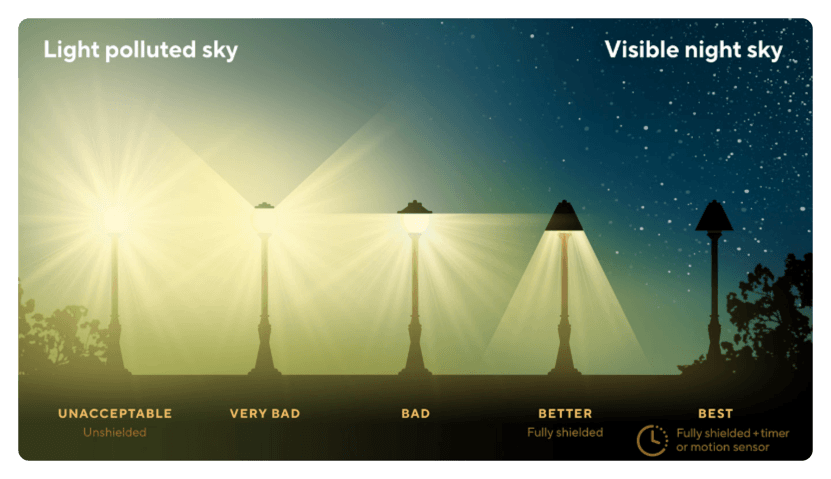
Definition of light pollution. Source: DarkSky International
According to the definitions of DarkSky International and the Illuminating Engineering Society(IES), light pollution from commercial signs mainly manifests in the following four forms:
- Skyglow: Artificial light emitted into the sky or scattered by the atmosphere, creating a giant “glowing dome” over the city. Skyglow obscures the natural starry sky. Today, approximately 80% of Americans cannot see the Milky Way at night due to skyglow.
- Light Trespass: High-intensity light spills beyond the intended boundaries. For example, the intense light from illuminated commercial signs shines directly into the bedroom windows of nearby residential areas or sensitive nature reserves late at night.
- Glare: Extremely high contrast between a strong light source and the surrounding darkness, causing visual discomfort. Glare is not only offensive but can also cause momentary visual impairment for drivers at night, posing a serious traffic safety hazard.
- Clutter: Bright, chaotic, and excessively dense lighting sources piled together. Clutter detracts from the aesthetics of the urban nightscape and easily distracts drivers in dense commercial areas.
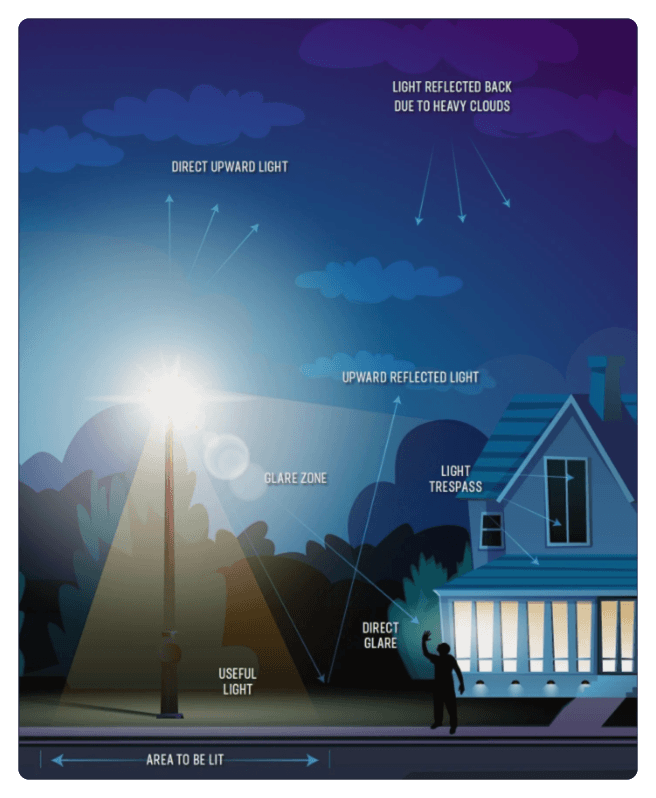
The three main manifestations of light pollution are: Skyglow, Glare, and Light Trespass. Source: Greater Big Bend International Dark Sky Reserve
How LED Signs Contribute to Light Pollution?
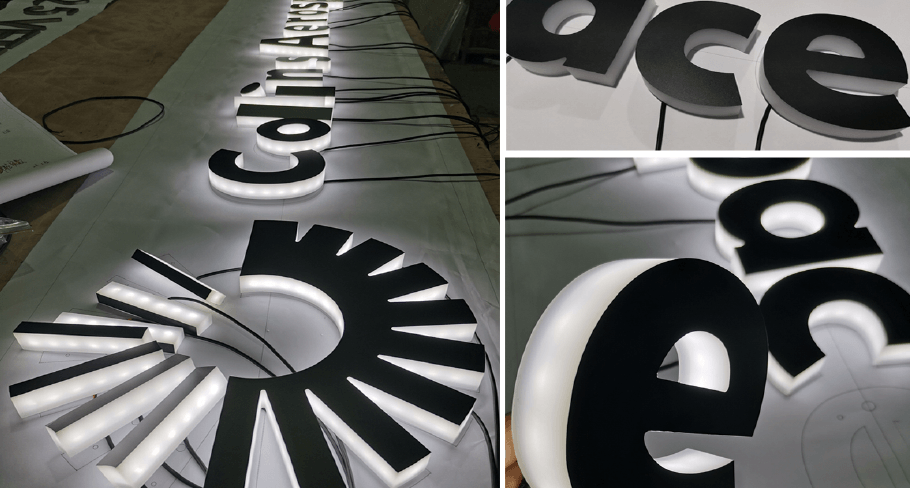
Although modern LED channel letters are usually static, they can generate significant light pollution if poorly designed due to the dense array of LED modules installed inside.
The core manufacturing processes and design flaws that cause LED signage to violate U.S. DarkSky regulations primarily include the following four points:
No Automatic Dimming
This is the main cause of nighttime glare. When setting the lumen output of LED channel letters at the factory, sign manufacturers often set a “general brightness” version to ensure visibility in most commercial environments. However, if the sign is not equipped with a photocell or is not manually dimmed as required after installation, it will become a glaring “high beam” at night when the surrounding environment darkens.
Light Leakage from Returns
This directly results in Light Trespass. Standard, high-quality 3D illuminated signage typically utilizes acrylic face panels paired with opaque aluminum alloy return edges. However, if the manufacturing facility employs poor welding techniques, executes rough grooving, or fails to professionally seal the seams of the return edges to block light, light will leak out haphazardly through the gaps.
Disordered Light Reflection in Halo-Lit Letters
Back-lit letter creates an elegant “halo effect” by casting light onto the building’s wall surface, resulting in a sophisticated visual aesthetic. However, if the mounting standoffs position the letters too far away from the wall, the light will reflect off the surface, causing light spill and exacerbating skyglow.
Excessive Blue Light
Many customers mistakenly believe that choosing 6000K to 7000K Cool White LED modules will make signs appear brighter and more eye-catching. From a physics perspective, Cool White contains a large amount of short-wavelength blue light. Blue light is easily scattered by dust and water molecules in the air at night (Rayleigh scattering). This not only causes a blurry, ghosting effect around the illuminated lettering, reducing readability, but also contributes significantly to urban sky glare and severely attracts insects. (For a more in-depth analysis of this topic, please read our industry feature: Do LED Channel Letters Attract Bugs?)
How the U.S. Regulates Light Pollution on LED Signs?
To effectively address light pollution, regulatory agencies must first establish a clear and quantifiable set of criteria to define when LED signs transform from a “dazzling marketing tool” into an “environmental nuisance.”
In the United States, compliance management for LED signage is not solely the responsibility of a single federal agency, but rather a patchwork system comprised of local zoning laws, state energy regulations, and national industry standards. To achieve compliance within this complex legal network, a deep understanding of the following core regulatory frameworks is essential:
The Foundation of Quantitative Management: The Bug Rating System
In U.S. outdoor lighting regulations, BUG is a common luminaire light distribution classification method used to describe a luminaire’s performance in three dimensions: Backlight, Uplight, and Glare. It is frequently used to assess the impact of outdoor luminaires on the surrounding environment, night sky, and visual comfort, and is particularly suitable for use in conjunction with local zoning ordinances, DarkSky requirements, and outdoor lighting codes. Many local regulations place special emphasis on U (uplight) and G (glare) controls to reduce sky glare and nighttime disturbances.
A Common Reference for Nighttime Brightness in the Signage Industry: The 0.3 Foot-Candle Rule
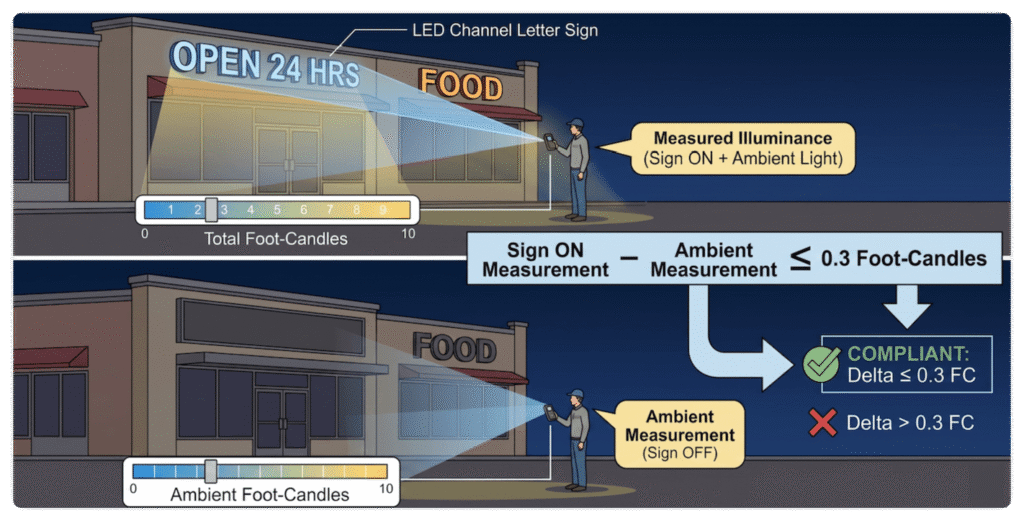
For LED signs and electronic billboards, the US industry and many local regulations often cite “0.3 foot-candle above ambient” as a nighttime luminance reference value. The core approach is not to directly measure the surface brightness of the sign panel, but rather to compare the difference in ambient illuminance when the sign is on and off at a specified measurement distance (as shown in the image below); this difference is typically required to not exceed 0.3 foot-candle. Because this method balances commercial visibility with the impact on the surrounding environment, it is frequently used in local signage regulations and outdoor lighting specifications.
Context-Specific Dynamic Management: Lighting Zones (LZ)
In the United States, outdoor lighting regulations typically classify projects into different lighting zones (LZ0 to LZ4) based on the environmental sensitivity of the area. LZ0 represents the most sensitive and darkest natural area, while LZ4 is suitable for a few areas with high-intensity nighttime use, such as special commercial or entertainment areas. Different LZs will affect local requirements for lighting power, shading, color temperature, glare, and control methods, but specific sign brightness, turn-off times, and allowable values still depend on state law, city regulations, or the building codes of the project’s location.
Taking Malibu as an example, the maximum recommended luminance by Lighting Zone (LZ) for Malibu is shown in the table below:
| Lighting Zone | Context | Max Nighttime Luminance (cd/m²) |
|---|---|---|
| LZ0 | Natural / Protected | 0 (EMCs strictly prohibited) |
| LZ1 | Low Ambient (Rural) | 20 nits |
| LZ2 | Moderate Ambient (Suburban) | 40 nits |
| LZ3 | Moderately High Ambient | 80 nits |
| LZ4 | High Ambient | 160 nits |
Note: Please distinguish between the surface brightness of the signage itself (measured in Nits) and the incremental illuminance cast upon the surrounding environment (measured in Foot-candles); local authorities apply distinct regulatory standards to each of these metrics.
State-Level Energy and Lighting Control Requirements: California Title 24
In addition to controlling brightness and reducing light pollution, some U.S. states also impose mandatory requirements on the control methods of LED signs through building energy codes. The most representative example is California’s Title 24 (related requirements of Part 6 of the Energy Standard). In California, many outdoor signs are required to use automatic control systems, such as astronomical timer switches or combinations of light and time control. For signs that are continuously illuminated day and night, automatic dimming at night is also required to reduce unnecessary energy consumption and nighttime light interference. Such requirements have also driven sign manufacturers to adopt more efficient LED light sources and more refined dimming control technologies.
Related Resource: Installing signage on the West Coast? Read our comprehensive California & Los Angeles County LED Channel Letter Installation Compliance Guide (2026 Edition) for a detailed breakdown of structural permit workflows, setback distances, and local mounting height limits.
Federal-Level Transportation Corridor Control: Highway Beautification Act
In the United States, one of the most important federal frameworks for large outdoor advertising along major transportation corridors is the Highway Beautification Act. This act primarily manages the location, spacing, size, and permitting conditions of billboards along interstate and major federal highways, reducing visual clutter and maintaining road aesthetics and driving safety. For illuminated signs, it has a greater impact on “whether they can be installed, where they can be installed, and their size,” rather than directly specifying brightness limits like local signage regulations.
How to Design and Install LED Signs That Comply in the U.S.?
To improve the compliance of LED signage across the United States, the following aspects should be considered during design and installation:
Brightness Control and Auto-Dimming
LED signs should be set with appropriate nighttime brightness according to local regulations, and can be used with light control, time control or automatic dimming systems to help meet local requirements for nighttime illuminance differences.
Comply with Requirements for Nighttime Shutdown or Dimming
Many local regulations set nighttime closing times, dimming times, or curfews for electronic signs; the specific times depend on the sign regulations of the project’s location.
Select the Appropriate Color Temperature
Many DarkSky-friendly regions prefer to use a color temperature of 3000K or warmer; some regions may also impose restrictions on higher color temperatures.
Restrict Dynamic Content
Many places restrict flashing, scrolling, frequent switching, or high-contrast animations and require each message to remain on screen for a certain period of time.
Optimize Installation Method
If external lighting is used, fully shielded luminaires should be preferred to reduce uplighting, glare, and light trespass; some regions may also impose requirements on the density, location, or spacing of electronic signs.
Complete On-site Measurement and Verification
After installation, an on-site test should be conducted using a lux meter in accordance with local regulations to confirm that the illuminance increment when the sign is on and off meets the requirements. A common reference value is 0.3 foot-candle above ambient, but the final standard shall be subject to local regulations.
Why Choose US?
Meeting U.S. compliance requirements for DarkSky and light pollution control takes more than simple assembly. It requires precise manufacturing, consistent craftsmanship, and a solid understanding of U.S. signage regulations.
At FT Signage, we not only focus on product craftsmanship, but also pay close attention to compliance. We believe that understanding the compliance background helps us better understand our clients’ needs and deliver the right solutions.
Contact us to get tailored solutions and project support.
References:
EMC Brightness Level Recommendations