Introduction
As a global manufacturing center, China has obvious advantages in the field of advertising signs and illuminated letters: a complete industrial chain, mature production technology, and strong large-scale cost control capabilities.
Taking illuminated channel letters as an example, raw material procurement, surface treatment, spraying, electroplating and assembly can often be efficiently coordinated within the same industrial zone, significantly shortening delivery time and reducing unit costs. This is why more and more U.S. billboard companies, importers and operations managers are beginning to turn their attention to the Chinese supply chain.
But importing advertising signs from China is not as simple as “finding a factory and placing an order.” Compliance requirements, customs declarations, logistics arrangements and quality control are all key factors that determine the success or failure of a project.
This article will focus on these core links to systematically sort out the complete process and precautions for importing advertising signs from China.
Before You Order: Preparation Steps
Once you decide to import custom advertising signs from China, the more complete the preliminary preparations, the smoother the subsequent implementation.
First of all, based on the actual display requirements of the project, you need to clearly define the product specifications. You must determine whether the product is LED channel letters, metal letters, or braille signs, and further confirm the key parameters such as material, size, voltage, and waterproof rating, while also completing the artwork design.
Secondly, it is necessary to understand the local compliance requirements in advance. Take California as an example. Title 24, DarkSky ordinances, light pollution regulations, as well as ADA accessibility standards, are all factors that must be considered before placing an order. If the project involves Braille, further confirmation of the requirements for Braille production and installation is also necessary.
Thirdly, supplier selection is of utmost importance. Instead of choosing a supplier that is new to the industry and has limited case studies, it is better to give priority to factories like FT Signage that have extensive experience in mature projects, export to the United States, and stable delivery capabilities.
Finally, it is necessary to clarify the type of import. Are you importing samples, advertising items, or formal commercial goods? Do you need an import license? Can the payment method be smoothly completed with the Chinese supplier? All these questions should be clarified before placing the order.
Checklist Before Ordering:
| Step | Key Points |
|---|---|
| Determine Product Specifications | LED channel letters, metal letters, Braille signs, material, size, voltage, waterproof |
| Review Compliance Requirements | Title 24, DarkSky ordinances, light pollution rules, ADA requirements for Braille |
| Screen Suppliers | Factory capability, past projects, certifications, U.S. export experience |
| Confirm Import Type | Sample vs. commercial shipment, import license requirements, payment feasibility |
Ordering Process
After the preliminary preparations are completed, the formal ordering process can begin. A standard ordering procedure usually consists of the following steps:
Request for Quote
You need to provide the supplier with clear requirements information, including:
- Product specifications (such as LED channel letters, metal letters, size, voltage, waterproof requirements, etc.)
- Quantity and delivery date
- Trade terms (FOB, CIF, DDP, etc.)
- Acceptance criteria (such as brightness, appearance, waterproof testing requirements)
Based on this information, the supplier will provide a quotation and offer the final price.
Sign Contract or Confirm PI (Proforma Invoice)
After both parties have agreed on the price, a formal contract should be signed according to the normal business process. However, for projects with a small quantity and a simple structure, in many cases, a PI (proforma invoice) is directly used as the contract, with the payment terms, product specifications, delivery date and acceptance criteria clearly stated.
After the payment is completed and the supplier confirms receipt of the payment, it can enter the production stage.
Production Process Supervision and Quality Inspection
During the production process, you can ask the factory to provide key quality evidence, such as:
- Pictures or videos of the production process
- Real shots of key processes such as LED module layout, welding, and assembly
- Test report before leaving the factory (brightness, waterproof, electrical safety, etc.)
For important projects, it is recommended to arrange mid-term inspection and pre-factory inspection to ensure that the product meets the agreed quality requirements.
Shipping
According to the contract, after the product manufacturing is completed, the supplier will arrange delivery and provide:
- Bill of Lading / Airway Bill
- Packing List
- Commercial Invoice
- Certificate of Origin (if required)
These documents are the basis for subsequent customs clearance and transportation and must be confirmed complete before shipment.
Shipping & Logistics
Once the product is manufactured, you have already won half the battle; choosing the right transportation and logistics solution is the other half.
Before arranging transportation, please confirm two points:
- Packaging Requirements
- Shockproof, moisture-proof and drop-proof
- Use wooden boxes or cartons, and clearly mark the outer box: box number, product name, quantity, destination, size, weight, etc.
- Freight Insurance
- It is recommended to insure the goods to avoid economic losses caused by damage or loss during transportation.
After that, choose the appropriate shipping method according to your actual needs. Generally speaking, importing advertising signs from China mainly involves three modes of transportation:
| Transportation Method | Applicable Scenarios | Notes for Attention |
|---|---|---|
| By Sea | Bulk, non-urgent cargo | 25-30 days, moisture-proof, sturdy packaging required |
| By Air | Small batch, urgent cargo | 15-20 days, shipping cost is higher |
| Express | When the volume and weight are small (< 100 KG) | 7-10 days, DHL/UPS/FedEx, customs clearance is relatively convenient |
Customs & Import Documentation
After a long journey, your goods finally arrived at the destination port, and now there is only one final step left – customs clearance.
Customs Clearance Documents
At this time, the various documents you prepared before will come in handy. For goods to enter the United States smoothly, the following core documents are generally required:
- Commercial Invoice: List buyer and seller information, product description, quantity, unit price, total price, trade terms (such as FOB, CIF, DDP), etc.
- Packing List: List the size, weight, number of pieces, and packaging method of each box in detail to facilitate customs inspection.
- Bill of Lading / Airway Bill: Cargo transportation contract and delivery voucher, use Bill of Lading for sea and Airway Bill for air.
- Certificate of Origin: Sometimes a certificate of origin is also required to prove that the goods originated in China, which is used for tariff calculation and trade statistics.
- Import License (if applicable): If the product belongs to a specific category of import-controlled goods in the United States, you need to apply for an import license in advance. Generally, advertising signs themselves are not compulsory, but if they involve special materials, electronic components or controlled categories, confirmation is required.
HS Code
Common HS Codes for advertising signs include:
- 9405.61: LED illuminated letters, LED light box(signs with lighting devices)
- 8310.00: Metal signs (without lighting)
- 8543.70: Electronic display screen, digital billboard (if with control system)
Different HS Codes correspond to different tariff rates. It is recommended to confirm the final classification with the customs clearance agency or freight forwarder.
Import Licensing and Control Requirements
The U.S. Customs and Border Protection (CBP) does not have mandatory import license requirements for general advertising signs, but the following situations may involve additional controls:
- Contains laser or special light source: May involve FDA regulation of laser products.
- Contains special materials or chemicals: For example, some coatings and paints may involve EPA or CPSC related standards.
- Commodity categories subject to trade sanctions or quotas: Need to confirm whether they fall within the scope of additional controls.
For most conventional advertising signs such as LED illuminated letters and metal signs, a special import license is usually not required as long as the above-mentioned special controls are not involved.
Tariff
Whether you need to pay tariffs when importing into the United States mainly depends on:
Tariff Rate Corresponding to The HS Code
- General LED illuminated letters: the tariff rate is around 5%–6% (depending on the specific classification).
- Non-luminous metal signs: some are Free, some are around 5%–6% (depending on the specific classification).
Section 301 Imposes Additional Tariffs on China
- Many Chinese-made LED products and electronic lighting products are included in the Section 301 tariff list and require additional tariffs ranging from 7.5%–25% on top of normal tariffs.
- The specific applicability needs to be confirmed based on the HS Code and product structure.
How to Check The Tariff Rate
To determine the correct U.S. tariff for your signage product:
Take a metal signs (non-luminous) as an example. Its HS Code is 8310.00.00. Visit https://hts.usitc.gov, Enter the HS Code 8310.00.00, and look under “Rates of Duty” → Column 1 → General. You will see “Free”, indicating that its basic tariff (General Rate) is 0%:
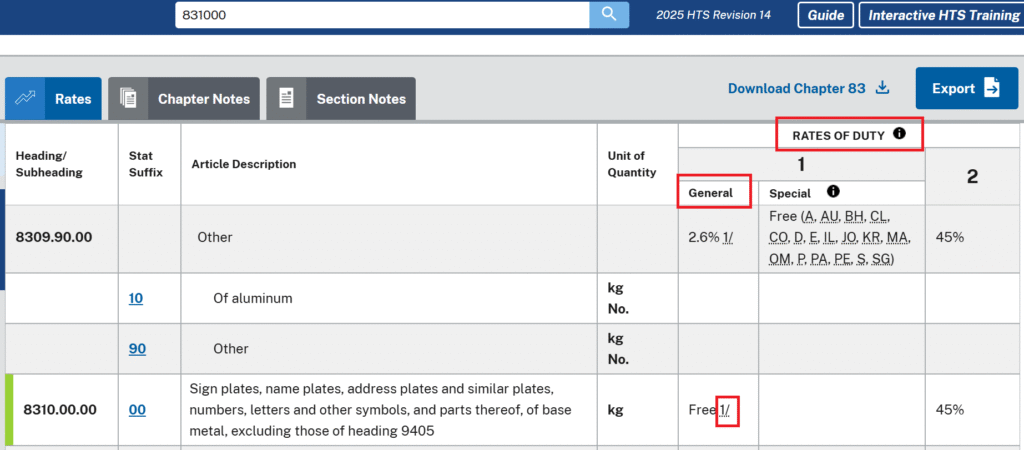
Then click on the footnote “1/”, it will prompt 25% duty, indicating that Section 301 imposes an additional 25% tariff:
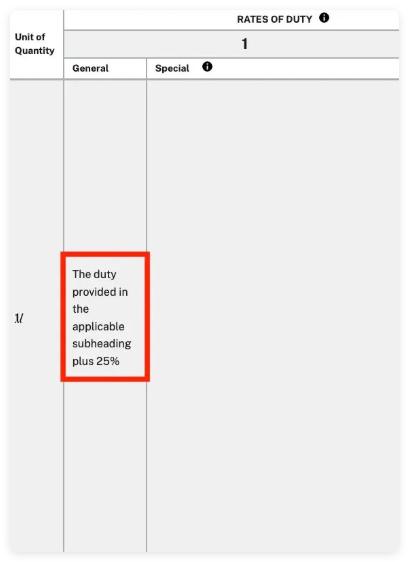
In addition, the fentanyl tariff was originally scheduled to be imposed in 2025, but this measure was canceled after the U.S. Supreme Court ruled it unconstitutional in 2026.
So the final total tariff for metal signs (non-illuminated) is 25%.
Note: Since the tariff policy has been dynamically adjusted, the final tariff imposed shall be subject to actual conditions. The above examples are for reference only.
Customs Clearance Process in Brief
- Before the goods arrive at the port: The customs clearance agency or freight forwarder will prepare documents and declare them to CBP.
- CBP Audit: Check documents, HS Code, tariff calculation, and whether further inspection is required.
- Pay taxes: If there are any duties or surcharges, they must be paid before release.
- Release and Pick-up: After CBP releases the goods, arrange to pick up the goods and transport them to the final destination.
Suggestion
- File ISF 48 hours before the ship leaves China (for ocean freight).
- Confirm the HS Code and tariff rate with the customs clearance agency or freight forwarder in advance to avoid classification disputes after arrival at the port.
- For LED products, verify compliance with UL/cUL electrical safety standards.
- For California projects, confirm in advance whether it meets local compliance requirements such as Title 24, DarkSky Ordinances, etc.
- Keep copies of all documents (invoices, packing lists, bills of lading, certificates of origin, etc.) for subsequent audits or rights protection.
Quality Control & Inspection
Quality control is the most overlooked but critical aspect of importing advertising signs from China. If many problems are discovered before leaving the factory, the cost is very low; once the product is shipped to the United States, the cost will increase exponentially if it is reworked or returned.
Pre-shipment Inspection
Before the product leaves the factory, it is recommended to ask the supplier to conduct the following key tests and provide test photos or video evidence:
- Brightness test
- Measure the brightness and uniformity of the LED illuminated letters to ensure that the brightness value meets the design requirements.
- Check whether there are problems such as uneven brightness, color deviation, dark areas in some areas, etc.
- Weather Resistance
- According to the product usage environment (indoor/outdoor), if it is used outdoors, confirm that the weather resistance meets the requirements.
- Confirm whether the sealing treatment at the junction box, power supply compartment, and interface is in place.
- Electrical Safety Test
- Check whether the power supply voltage matches the US standard (110V/120V).
- Test whether the circuit is stable and whether there is any risk of short circuit, overload, or leakage.
- Confirm whether key components such as LED drivers and transformers comply with UL/cUL standards.
For important projects, it is recommended to arrange mid-term inspection (during the production process) and pre-factory inspection (product completed but not packaged) to ensure that key processes (such as welding, assembly, sealing) meet quality requirements.
Receiving Inspection
After the goods arrive in the United States, they should be inspected before installation, including:
- Appearance inspection
- Check the box, panel, and frame for scratches, deformation, rust, paint peeling, etc.
- Check whether the welding points are flat and whether there are any weak or missing welds.
- Functional Test
- Power on and test whether the LED is working normally, whether there is dead light, flickering, or abnormal color.
- Check whether the control system (such as remote control, timing, brightness adjustment) is operating normally.
- For waterproof products, a simple water spray test can be performed again to confirm the waterproof effect.
- Size Check
- Compare the artwork and design drawings to check whether the actual size, thickness, and mounting hole locations are accurate.
- Confirm whether the installation accessories (brackets, screws, fixings) are complete and meet the specifications.
Common Quality Problems and Solutions
| Problem Type | Common Symptoms | Recommended Preventive Measures |
|---|---|---|
| LED dead lights | Some LEDs do not light up, flicker, or show abnormal colors | Perform a full lighting test before shipment and require the supplier to provide test videos |
| Poor weather resistance | Weak sealing allows water ingress; colors fade or age quickly | Specify weather-resistant materials and ensure proper sealing treatment |
| Voltage mismatch | The product does not work properly or the power supply is damaged | Clearly label 110V/120V, and require the supplier to provide power specifications and relevant certificates |
| Welding defects | Poor solder joints, leaks, or uneven weld points | Require mid-production inspection and check critical welding processes |
| Appearance damage | Scratches, deformation, or paint peeling | Strengthen packaging protection and require a pre-shipment appearance inspection |
Post-Import: Installation & Compliance
After receiving the goods and confirming that there are no quality issues, the next step is to ensure that the installation complies with U.S. federal and local regulations. Compliance priorities vary for different types of advertising signs.
Installation and Compliance Requirements for LED Illuminated Letters
For LED channel letters, you need to pay attention to the following key items before installation:
- Permits
- A sign permit and an electrical permit are required before installation.
- These permits are usually approved by the local city or county building department to ensure the sign is structurally safe and electrically safe.
- Projections and Clearance Requirements
- The protruding parts of the sign (such as the distance the channel letters protrude from the wall) must comply with local building regulations to avoid affecting the safety of pedestrians and vehicles.
- It is usually required to maintain a certain clearance height below the protruding part to avoid the risk of collision.
- Energy Efficiency & Green Building Compliance
- LED illuminated letters must comply with local energy efficiency standards, such as California’s Title 24 energy conservation regulations.
- Some regions may require the use of high-efficiency LED drivers with brightness adjustment capabilities to comply with green building standards.
For more detailed installation compliance guidelines, please refer to:
California & Los Angeles County LED Channel Letter Installation Compliance Guide (2026 Edition)
This article systematically sorts out key content such as permit requirements, projection clearance regulations, and energy efficiency standards in California and Los Angeles County.
Light Pollution and DarkSky Compliance
After the LED illuminated letters are installed, they must also comply with U.S. DarkSky and Light Pollution Laws, including:
- DarkSky Ordinances: Limit the brightness and illumination angle of signs to prevent light from directly affecting the night sky and surrounding environment.
- Light Pollution Limits: Control the light interference of signs on surrounding residences and roads to avoid glare and excessive lighting.
- Some cities may have specific requirements for the maximum brightness value and off time of signs (such as automatically reducing the brightness at night).
For more details, please refer to:
Are Your LED Signs Compliant? Navigating U.S. DarkSky and Light Pollution Laws
This article explains in detail the US DarkSky regulations, light pollution restrictions, and how to design LED signs in compliance.
Compliance Requirements for Tactile Braille Signs
For tactile Braille signs, compliance requirements are more stringent and mainly involve:
- ADA (Americans with Disabilities Act) Accessibility Standard
- Braille character size, font, spacing, and height must comply with ADA regulations.
- The sign surface must be tactilely readable and the Braille raised height must meet the standard.
- The installation location needs to be accessible to visually impaired people, usually within a certain height range.
- Material and Durability Requirements
- The material needs to be wear-resistant and corrosion-resistant to ensure that it will not fade or be damaged after long-term use.
- The surface needs to be non-slip and easy to clean to avoid affecting tactile recognition.
- Installation Location and Visibility
- The sign needs to be installed on or near the door to facilitate identification by the visually impaired.
- Some areas require signs to have backlighting or high contrast to improve visibility.
For more detailed Q&A on Braille sign compliance, please refer to:
FAQs for Tactile Braille Signs
This article systematically summarizes key issues such as the material, size, installation location, and ADA standards of Braille signs.
Suggestion
- Check with your local city or building department for permit requirements and local compliance standards before installation.
- For LED products, verify compliance with UL/cUL electrical safety standards and Title 24 energy efficiency requirements.
- For Braille signage, ensure compliance with ADA accessibility standards to avoid subsequent retrofit or fines.
- Keep all installation files, permit approval records, and test reports for subsequent audits or rights protection.
Cost Breakdown
What is the total cost of a typical advertising sign?
This question cannot directly give a fixed number, because advertising signs are not standardized products, but customized according to customer needs. Pricing is quoted based on each project’s artwork, specifications, dimensions, quantity, and finishing requirements.
Prices can vary significantly from project to project.
But based on experience, I can tell you the approximate proportion of the cost of each part in a typical advertising sign project, as shown in the following table:
| Item | Percentage | Notes |
|---|---|---|
| Product Cost | 40-50% | This cost is relatively fixed; while influenced by raw material prices and process complexity, it experiences minimal fluctuations. |
| Sea / Air Freight | 30-40% | Shipping costs are heavily affected by weight/volume, logistics methods, fuel prices, and international geopolitics. They tend to surge significantly during times of uncertainty, making up a higher share of the total cost. |
| Customs Duties | 25-30% | The duty rate is determined by the HS Code. If the product falls under Section 301, an additional 25% tariff will be levied on top of the general rate. |
Note: These percentages represent typical ranges for individual cost components. Because shipping rates fluctuate and tariffs vary by HS code, the total breakdown will vary per project.
Common Pitfalls & How to Avoid Them
Importing advertising signs from China may seem simple, but in actual operation it can easily lead to pitfalls. Here are some of the most common problems and suggestions for how to deal with them:
| Pitfall | Common Issues | How to Avoid It |
|---|---|---|
| Voltage Mismatch | The product fails to work, or the power supply burns out. | Clearly specify 110V/120V (U.S. standard) before placing the order, and require the supplier to provide the exact power supply specifications. |
| Lack of Compliance & Certification | Fails to pass local inspections, requiring costly rework. | Request compliance certificates such as UL/cUL, CE, or FCC from the supplier to ensure the product meets U.S. standards. |
| Inadequate Packaging Leading to Damage | Goods arrive deformed or broken at the destination port. | Require the use of wooden crates combined with moisture-proof and shock-absorbent packaging, with clear product details labeled on the exterior. |
| Missing Customs Documentation | Shipment gets stranded at the port, incurring extra fees. | Prepare all essential documents well in advance (including the Commercial Invoice, Packing List, Bill of Lading, Certificate of Origin, etc.). |
| Supplier Lacks Export Experience | Delayed lead times and unstable product quality. | Prioritize factories with proven U.S. export experience and successful project case studies (such as FT Signage). |
Core Principle: Don’t just look at the price, but also the supplier’s delivery capabilities, quality experience and compliance awareness.
Conclusion
Importing advertising signs from China is a systematic process, involving product specifications, compliance requirements, supplier screening, ordering process, transportation logistics, customs clearance documents, quality control, installation compliance and other aspects.
The key to success is:
- Sufficient preparation in advance (specifications, compliance, suppliers)
- Choose experienced suppliers (with US export cases and certifications)
- Pay attention to quality control (pre-factory inspection, arrival acceptance)
- Complete customs clearance documents (invoice, packing list, bill of lading, certificate of origin)
- Compliant with US regulations (Title 24, DarkSky, ADA, etc.)
It is recommended that you start with small batch samples to verify the supplier’s delivery capabilities and product quality, and then gradually expand the order size.
If you have any questions, please feel free to contact FT Signage, we are willing to provide you with full-process support from product customization to import compliance.
Reference:
CSMS # 67834313 – Ending Collection of International Emergency Economic Powers Act Duties
N239369: The tariff classification of LED messaging signs from China