
In accordance with the newly adopted regulations by the California Building Standards Commission (CBSC) and Los Angeles County, all electronic sign installations—including LED Channel Letters—within this jurisdiction must strictly adhere to the applicable technical and administrative compliance requirements. This guide outlines the key 2026 rules covering permits, electrical standards, installation clearances, energy-code compliance, and UL certification for fabricators, installers, and project teams.
Core Regulatory Framework & Applicable Standards
To implement illuminated signage projects in California, three major standards must be met simultaneously: product certification, on-site installation, and local regulations.
- Product Safety & Manufacturing Standard (UL 48): Published by UL Standards & Engagement, this standard governs the structural integrity, internal wiring, and damp/wet location enclosures of electric signs.
- Field Installation & Electrical Conduit Standard (CEC/NEC): Enforced via Title 24, Part 3, California Electrical Code (CEC). Field construction must strictly follow Article 600 (Electric Signs and Outline Lighting).
- Local Amendments: Los Angeles County officially adopted and enacted the 2026 Los Angeles County Electrical Code (Title 27) and Building Code (Title 26), effective January 1, 2026.
Key 2026 NEC Revision Note:
According to the latest revised NEC/CEC 600.4 section, field enforcement has streamlined the redundant review of markings, and fully centralized the labeling details at the manufacturing level under the UL 48 standard to eliminate the standard conflict between field inspection and factory certification.
Administrative Compliance & Permits
Before any LED signage installation, modification, or structural retrofit begins, dual permits must be obtained from the local Authority Having Jurisdiction (AHJ), such as the Los Angeles County Department of Public Works (Building and Safety Division):
- Sign Permit: Reviews sign dimensions, structural attachment, and projections to ensure alignment with local zoning ordinances and the Building Code (Title 26).
- Electrical Permit: Any illuminated sign connected to a line-voltage branch circuit or a Class 2 power supply requires a standalone electrical permit, which must be pulled by a licensed electrical contractor (C-10).
Failure to secure both permits prior to installation may result in a Stop Work Order, substantial administrative fines, and mandatory removal of the unpermitted structure.
Sign Identification & Nameplate Requirements
According to the 2026 Building Code Amendments (2026 Codes Adopt (Adopted), Section H104.1 Identification), all outdoor illuminated signs that project from a structure or are free-standing—excluding wall signs attached flush to the exterior wall without projection—must display a permanent, weather-resistant nameplate in a conspicuous location on the exterior of the sign, containing:
- The legal name of the individual, firm, or corporation responsible for the installation or maintenance of the sign.
- The total dead load (weight) of the sign to verify structural loading.
- An approved sign identification method or the local AHJ-issued permit number.
Projections and Clearance Requirements
Projections and Clearances
Illuminated signs must not obstruct any fire escape, fire door, exterior exit balcony, or mechanical ventilation openings (2026 Codes Adopt (Adopted), Section H103.1 Location restrictions). When encroaching over public rights-of-way, installations must strictly comply with the following vertical and horizontal redlines:
| Application / Zone | Vertical Clearance Requirement | Maximum Allowable Projection | Core Restrictions & Conditions |
|---|---|---|---|
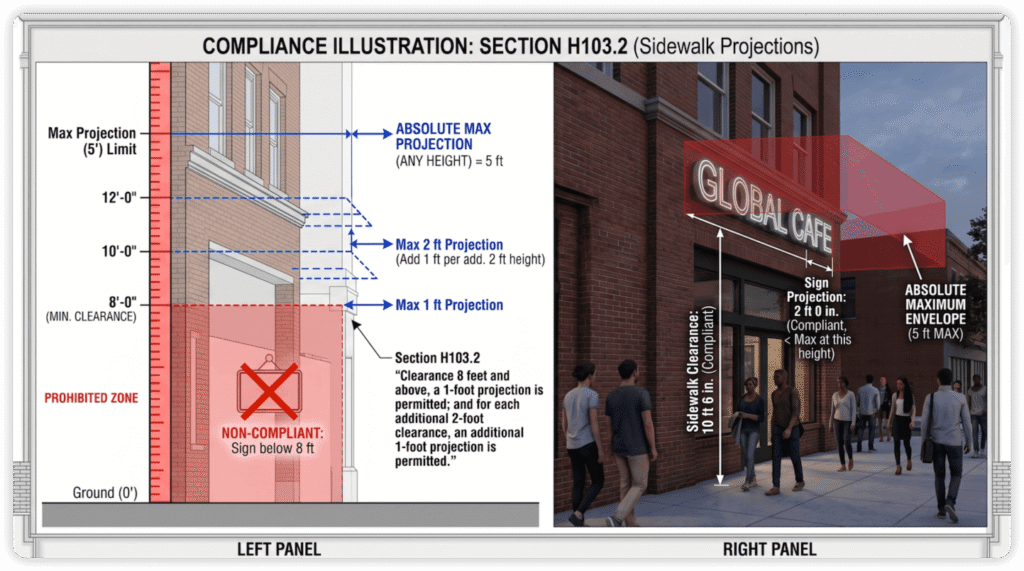
| Public Encroachment (Street, Sidewalk, or Building Line) | Less than 8 feet (2438 mm) | Prohibited | No sign is permitted to project over public property if its bottom is below 8 feet. |
| Public Encroachment (Baseline Standard) | 8 feet (2438 mm) and above | 1 foot (305 mm) | A baseline 1-foot projection is permitted once the 8-foot vertical clearance is met. |
| Public Encroachment (Incremental Scaling) | For each additional 2 feet (610 mm) of clearance | Additional 1 foot (305 mm) | Projections scale with height (e.g., a 10-ft clearance allows a 2-ft projection; a 12-ft clearance allows a 3-ft projection). |
| Public Encroachment (Absolute Maximum) | Any clearance height | 5 feet (1524 mm) | Absolute limit: No sign structure shall have a horizontal projection exceeding 5 feet. |
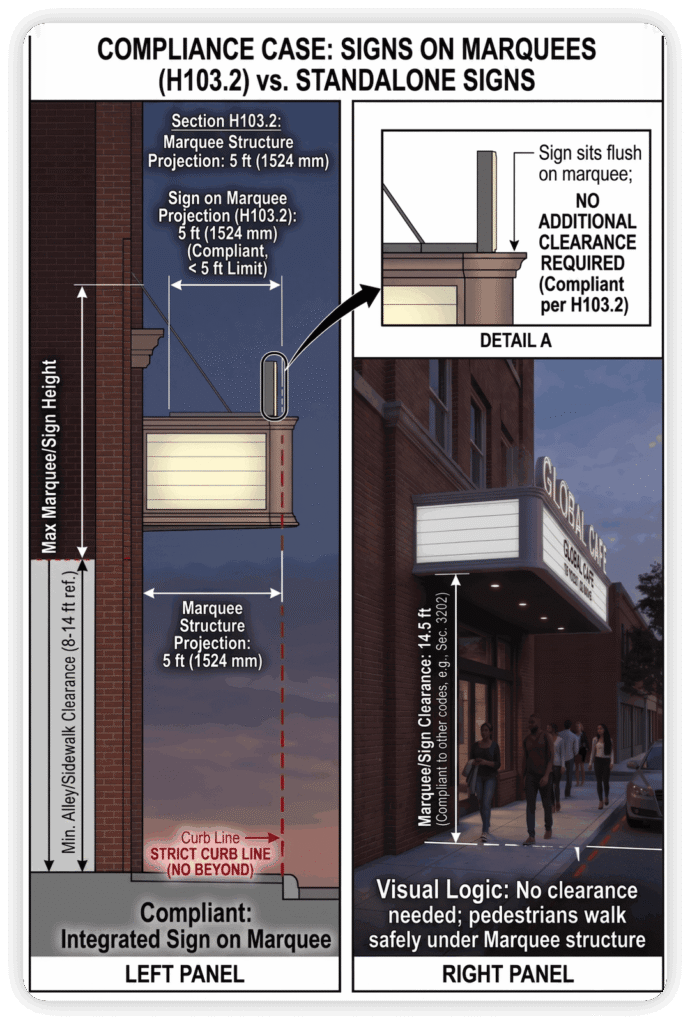
| Signs on Marquees | No clearance required between sign and marquee | 5 feet (1524 mm) | A projecting sign built above and in connection with a marquee may extend up to 5 feet. |
| Curb Line Limitation | Any height above grade | Cannot project beyond curb line | Regardless of clearance height, no structure shall project beyond the street curb line. |
| Private Property (Used/intended for the general public) | Minimum 8 feet (2438 mm) | More than 6 inches (152 mm) | If a sign projects more than 6 inches from the building face, it must maintain an 8-foot clearance above the sidewalk or grade. |
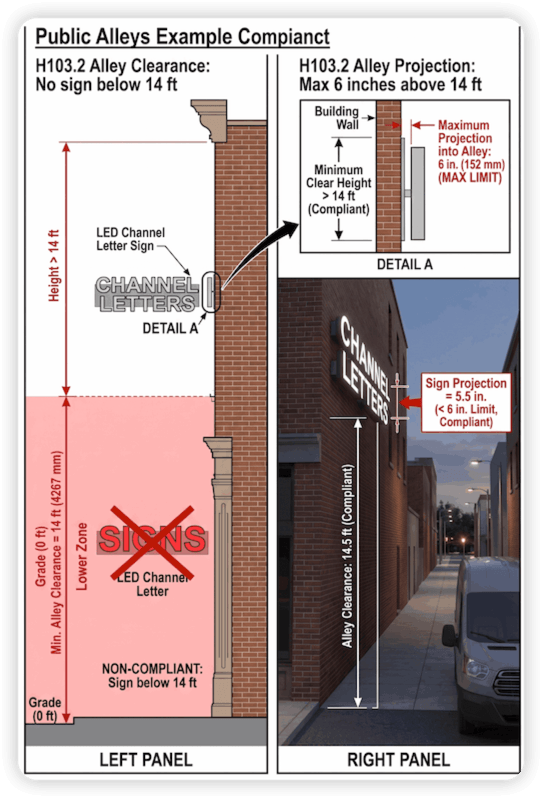
| Public Alleys (Lower Zone) | Below 14 feet (4267 mm) | Prohibited | No sign shall project into any alley whatsoever below a height of 14 feet. |
| Public Alleys (Upper Zone) | 14 feet (4267 mm) or more | Maximum 6 inches (152 mm) | No sign shall project into any alley by more than 6 inches when its height is 14 feet or more above grade. |
To make it easier to understand, I have drawn three scene diagrams.
The scene diagram for public streets is shown below:
The scene diagram for public alleys is shown below:
The scene diagram for marquees is shown below:
Note: While complying with local zoning codes in Los Angeles dictates where you can legally install a sign, understanding the physical build, material selection, and mounting methods of the signage itself is the key to a seamless installation. For a deep dive into these technical details, please refer to our comprehensive guide: Front-Lit Channel Letters: Structure, Materials, and Installation
Why Do Installation Limits Vary So Widely by Scenario?
Public Streets & Alleys – The core principle is “scratch prevention”: The extremely stringent requirements for height and thickness (projection distance) (e.g., alleyways require a height of 14 feet or more and a thickness of only 6 inches) are primarily to ensure that tall vehicles such as garbage trucks, fire trucks, and vans absolutely will not scratch the building’s exterior signage when passing or parking, thus preventing secondary safety hazards such as structural collapse.
Signs on Marquees – The core principle is “structural attachment”: The compliance logic for marquees is completely different. Because a marquee is already a large, protruding structural element of the building, its clearance has already passed independent acceptance by building codes (such as Section 3202) in the early stages. Pedestrians or tall vehicles cannot directly walk onto the space at the top of the marquee; therefore, illuminated signs placed on it are directly exempt, without requiring additional clearance. As long as the projection distance of the sign does not exceed 5 feet and does not extend beyond the curb line, it is considered to be compliant.
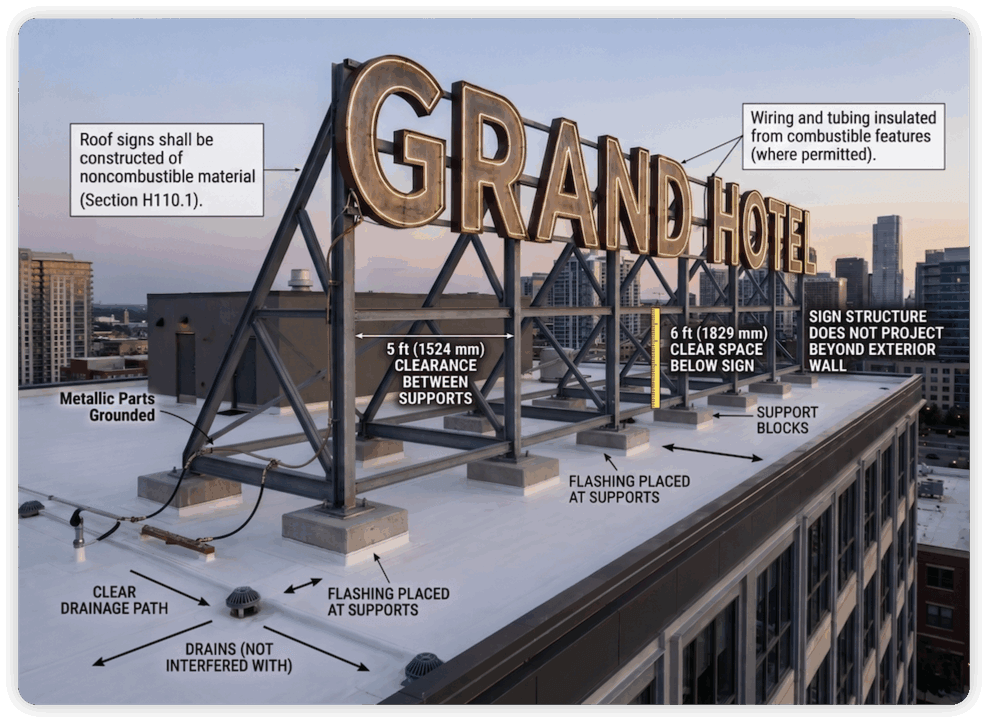
Roof Signs Special Provisions (2026 Codes Adopt (Adopted), Section H110.1 – General)
Materials & Grounding: Roof signs shall be constructed entirely of metal or other approved Class A noncombustible materials. Provisions must be made for the proper electrical grounding of all metallic structural parts.
Spatial Limitation: No part of the roof sign structure shall project beyond an exterior wall projection line.
Vertical Clear Space Redlines:
- Standard / Inaccessible Roofs: The sign must be constructed so as to leave a clear vertical space of not less than 6 feet (1829 mm) between the roof level and the lowest part of the sign. Additionally, a clear horizontal distance of not less than 5 feet (1524 mm) must be maintained between its vertical structural supports.
- [Flat Roof Exception]: Signs installed on flat roofs, where every part of the roof surface is accessible, shall not be required to provide clear vertical space between the roof level and the lowest part of the sign. The signage is permitted to sit flush or near the roof plane.
Drainage & Flashing: Base blocks, angles, or structural supports fastened to the roof must be engineered and located so as not to interfere with the natural drainage of the roof. Approved flashing or counter-flashing must be installed wherever the roof membrane is penetrated or secured.
A typical roof sign installation diagram is shown below:
Energy Efficiency & Green Building Compliance
California enforces some of the nation’s strictest building energy efficiency standards:
- Title 24, Part 6 (California Energy Code): All illuminated signs and their associated control systems (e.g., photocells, astronomical time switches) must undergo mandatory Sign Lighting Acceptance Testing upon completion. This documentation must be certified by a registered Acceptance Test Technician (ATTCP).
- Title 31 (Los Angeles County Green Building Standards Code): Signage installations must comply with 2026 local green building targets, including maximum allowable lighting power density (W/sq.ft.) and material recyclability thresholds.
Manufacturing Standards & UL Certification
The LED channel letter system itself must be legally listed and labeled for market entry:
- End-Product Listing: The complete, fully assembled LED channel letter system must bear a UL or cULus (US and Canadian markets) Listing Mark prior to leaving the factory.
- Component Compliance: All internal sub-assemblies—including LED modules, Class 2 power drivers, terminal blocks, and external disconnect switches—must be UL 879 (Standard for Electric Sign Components) Recognized and marked accordingly.
Beyond UL 48 certificate, California Electrical Code (CEC) Article 600, Energy Code and Los Angeles County’s sign code, many U.S. jurisdictions also reference DarkSky-friendly standards and broader light pollution regulations for LED signage. If you want to understand how these wider rules affect your projects, check this U.S. DarkSky and light pollution compliance guide for LED signs.
FAQ
Do I need both a sign permit and an electrical permit?
In most cases, yes. The sign permit covers zoning and placement, while the electrical permit covers the powered installation.
What code applies to LED channel letters in California?
The main layers are UL 48 for product safety, CEC / NEC Article 600 for electrical installation, and the applicable local county codes.
Do illuminated signs need acceptance testing in California?
Yes, for applicable projects under Title 24, Part 6, acceptance testing is part of the compliance path.
What is the minimum clearance above sidewalks?
The common minimum is 8 feet, while alley clearances are typically 14 feet.
Is acrylic noncombustible (fireproof)?
No. Acrylic is plastic. It is legally classified as a combustible material because it melts and burns when exposed to flame or electrical shorts.
The code requires “noncombustible materials” for roof signs, can I still use acrylic?
Yes, where combustible materials are permitted in letters or other ornamental features, wiring and tubing shall be kept free and insulated therefrom.
What is the wiring rule for acrylic sign faces on a roof?
All internal LED wiring and power supplies must be completely tied back and insulated from directly touching the acrylic. This prevents electrical arcing from setting the plastic face on fire.
What happens if a roof sign fails material compliance?
The city inspector will fail the inspection immediately. You will not get power clearance, and you will be forced to take the sign down or retrofit it at your own expense.
Take Away
While LED channel letters provide premium visibility, their installation is governed by strict, scenario-specific building codes. When planning your layout, never assume one installation standard fits all. For instance, a sign requires a 14-foot clearance in a public alley to prevent vehicle collisions, yet it can sit flush with zero clearance on a marquee.
Therefore, we advise clients to confirm the precise municipal codes and structural restrictions of their specific site before placing an order.
At FT Signage, we focus on the technical precision of every illuminated element. Accuracy in architectural signage is a matter of structural integrity, fire mitigation, and legal safety. We are committed to working through these complex code details with you to ensure your project seamlessly passes city inspection.
Feel free to contact us to discuss your specific project specifications.
Referenced Legal Codes & Standards
UL 48 Standard For Electric Signs
NFPA 70: National Electrical Code (NEC 2026)
California Electrical Code (Title 24, Part 3)
Los Angeles County Building Code (Title 26) & Electrical Code (Title 27), 2026 Adopted Codes
California Energy Code (Title 24, Part 6)
The International Sign Association (ISA)
Acceptance Test Technician Certification Provider Program – ATTCP