
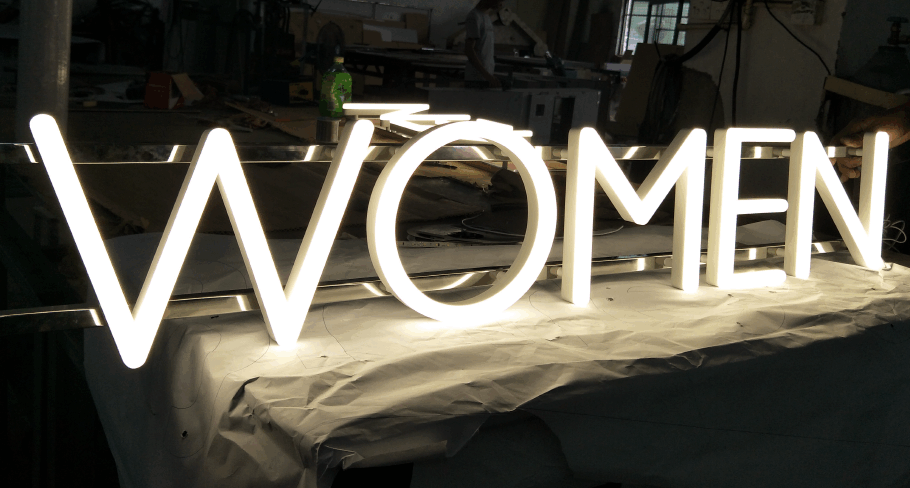
In today’s world, simplicity is the trend, and in the field of channel letters, trimless front lit letters are a prime example of this trend. Compared to traditional illuminated letter structures with trim caps, trimless designs offer a cleaner and more streamlined visual effect, making them widely used in high-end commercial spaces and brand storefronts.
This article is a concise guide to trimless front lit letters, primarily covering their structure, fabrication process, and typical applications. By systematically outlining these key points, it helps you quickly understand the core characteristics and practical value of trimless front lit letters.
Whether you are involved in signage design, manufacturing, or need to choose the right illuminated signage solution for your project, this guide will provide you with clear and practical references.
What Are Trimless Front Lit Letters?
Trimless front lit letters are a type of front-lit letter structure that eliminates the traditional trim cap. Its core feature is that the luminous surface is seamlessly connected to the edge of the letter shell, thus presenting a more concise and modern visual effect.
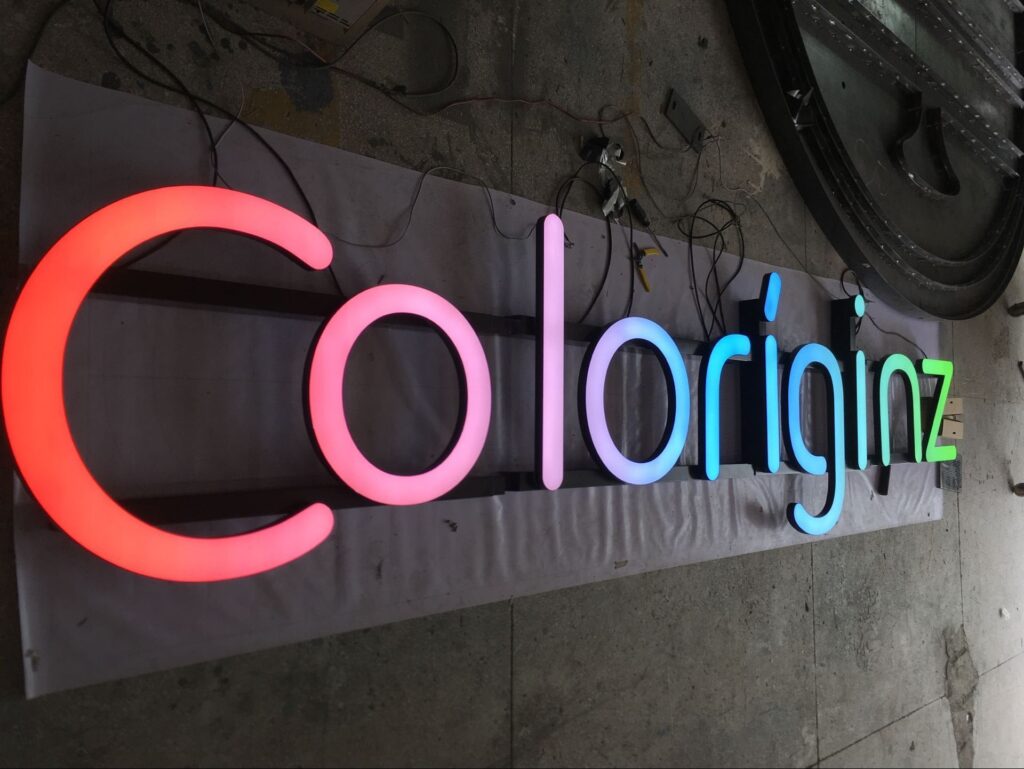
In traditional front-lit channel letters, the acrylic panel is typically fixed to the letter casing using a trim cap. The trimless structure, however, employs an embedded or adhesive process to directly fix the panel inside the letter casing or at the edge, eliminating the exposed border. This design not only improves the overall aesthetics but also results in more uniform light emission and cleaner edges, as shown in the image below:

What is the Structure of Trimless Front Lit Letters?
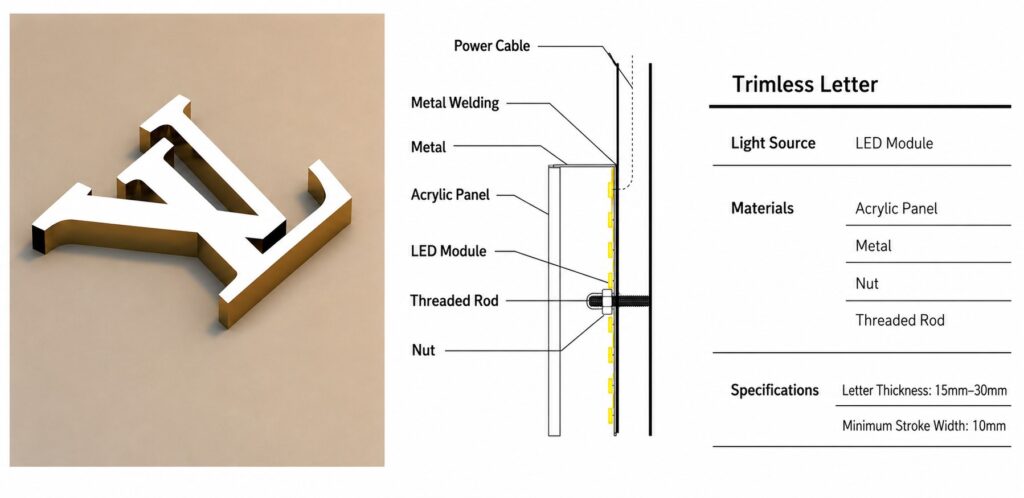
Structurally, trimless front lit letters typically consist of several key components: a metal letter shell (such as aluminum or stainless steel), a translucent panel (such as acrylic or polycarbonate), and an internal LED lighting system. Because the traditional trim cap is eliminated, this type of structure places higher demands on manufacturing precision, panel fit, and overall assembly processes, thus making it more suitable for commercial environments where visual quality and detail are paramount.
As shown in the example of the trimless front lit letter below, its typical structure is clearly visible: the front panel is made of acrylic, the back and returns are made of metal, and an LED module is installed inside as the light source. Nuts and threaded rods are used to mount and secure the overall structure. This combination ensures structural stability while also meeting the design requirements of uniform light emission and a clean appearance:
How Are Trimless Front Lit Letters Constructed?
The manufacturing process of trimless front lit letters is not complicated overall, but it requires high precision in processing and assembly. Because the traditional trim cap is eliminated, each process needs to be strictly controlled to ensure that the finished product has clean and crisp edges, good fit, and uniform light emission.
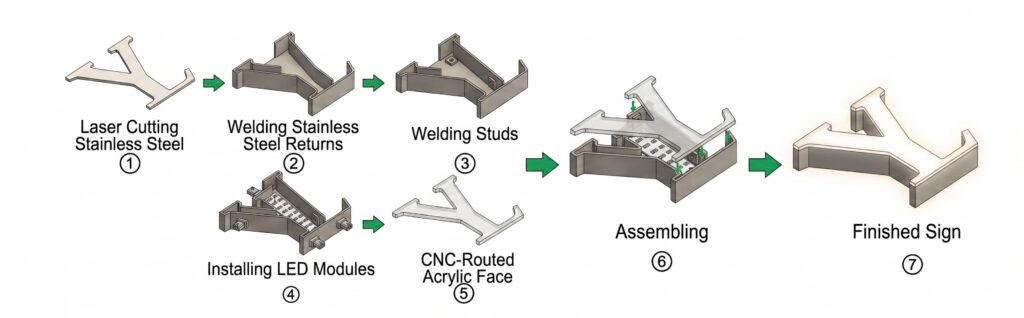
A typical trimless front lit letter usually involves the following seven manufacturing steps:
- Laser Cutting Stainless Steel
- Welding Stainless Steel Returns
- Welding Studs
- Installing LED Modules
- CNC-Routed Acrylic Face
- Assembling
- Finished Sign
The entire manufacturing process, as shown in the image below, encompasses key steps such as metal processing, acrylic processing, and precision assembly, all working together to achieve a trimless visual effect:
What Are the Application Scenarios for Trimless Front Lit Letters?
With their sleek, clean design and sophisticated visual appeal, trimless front lit letters are widely used in various commercial environments where brand image and spatial design are paramount. Compared to traditional illuminated signs, their frameless design blends seamlessly into modern architecture and interior spaces, creating a more refined and unified visual effect.
For instance, global tech leaders like Microsoft and AMD frequently adopt this trimless style to maintain a sleek, high-tech corporate identity:

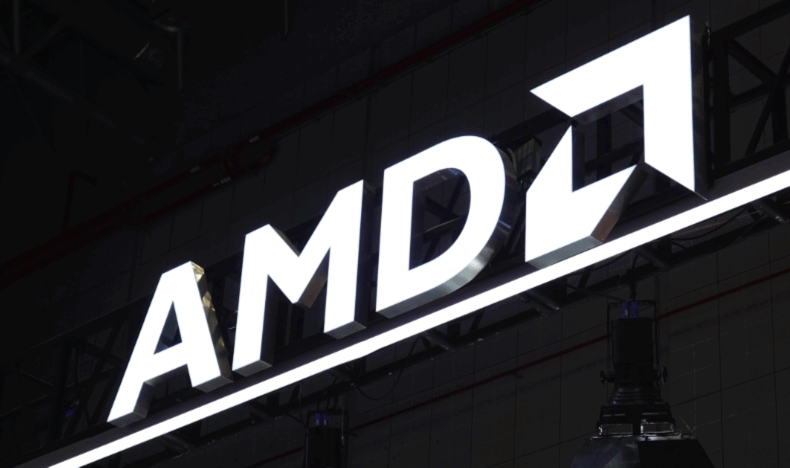
In practical applications, trimless front lit letters are commonly seen on retail brand storefronts, high-end shopping mall wayfinding systems, corporate headquarters signage, hotel and commercial complex signage, and various indoor and outdoor feature walls. This form of illuminated lettering is particularly advantageous in projects that emphasize minimalist design, high-quality details, and brand identity.
Furthermore, as brands continue to demand visual consistency and spatial experience, trimless front lit letters have gradually become one of the preferred solutions in high-end signage projects.
FAQ
What are the advantages of trimless front lit channel letters?
Trimless front lit channel letters provide a seamless, modern appearance without visible trim caps, resulting in cleaner edges and improved visual consistency. They also offer more uniform illumination, making them ideal for high-end retail, corporate, and architectural signage.
If you feel that trimless front lit channel letters do not meet your requirements, check out our comprehensive guide on What Are the Different Types of Channel Letters? to find the perfect fit for your brand identity.
What materials are commonly used for trimless front lit sign faces?
Acrylic is the most commonly used material due to its excellent light diffusion, durability, and CNC machinability. Polycarbonate may also be used where higher impact resistance is required.
Can trimless front lit letters be used outdoors?
Yes, but with size and height limits. Because they lack a traditional trim cap to mechanically clamp the edges, they are not recommended for extra-large sizes or high-altitude outdoor installations. Over time, high winds and extreme thermal expansion can cause large acrylic panels to warp or even detach. For massive or high-rise signs, a structured alternative with trim caps is safer.
How are trimless front lit letters installed?
They are typically installed using stud mounting for a clean, floating look, or raceway mounting for easier wiring and alignment. The method depends on project requirements and site conditions.
I have included these installation methods in below article(installation method is the same as front-lit letters):
Front-Lit Channel Letters: Structure, Materials, and Installation Guide
Take Away
In fact, regardless of the country or region, the realization of high-quality commercial signage cannot be separated from three core dimensions: structural precision, luminous uniformity, and compatibility with the spatial environment.
When selecting Trimless Front Lit Letters, it is recommended to focus on the following three key elements:
- Structure: Eliminating the traditional trim cap requires ensuring precise and seamless integration between the acrylic panel and the metal edging (stainless steel or aluminum) to achieve a clean, sharp edge and improve overall waterproofing.
- Fabrication: A standardized manufacturing process is crucial, including laser cutting, edging welding, stud installation, LED module placement, and high-precision CNC engraving and assembly, directly determining the final quality.
- Installation: Stud mounting is typically used, secured with nuts and threaded rods, achieving a stable installation while presenting a clean, floating visual effect.
As a professional manufacturer in the signage industry, FT Signage not only focuses on the product craftsmanship itself, but also pays close attention to global design trends and technological developments to ensure that it provides customers with signage solutions that are both aesthetically pleasing and reliable.
Welcome to contact us to get tailored solutions and project support.