
Imagine this: The LED channel letters have just arrived on site, you power them on for inspection, and find out that one “Pure White” letter you required looks a little bit yellowish.
Although this looks like a simple defect, LED color inconsistency is a complicated technical issue. The reason for LED color inconsistency mainly involves Binning, Phosphor Ratio & Uniformity, Color Temperature Deviation, as well as external factors such as voltage drop, channel letter panel differences, and aging.
Below, we will analyze these factors one by one.
Part 1: LED Color Variation Factor Analysis
Binning
The production of LEDs is very complicated; even if they come out from the same machine, using one batch of raw materials, the LEDs still have slight differences in wavelength (color) and brightness.
In order to avoid the impact of these differences, after the LEDs are manufactured, the factory will run tests, and based on the different characteristics of the LEDs, such as color, brightness and voltage, sort the LEDs into different “storage bins”; this process is called Binning.

High-end brands (such as Samsung and Osram) will perform Binning very detailedly, making sure that there is no difference to the naked eye. But for some middle to low end brands, the Binning will be more rough, or they just mix it and sell directly, causing color inconsistency in the same batch of LEDs.
Phosphor Ratio & Uniformity
According to the luminescence principle of LEDs, the LED’s white light is overlaid with a blue LED chip and yellow phosphor, as shown in the figure below:
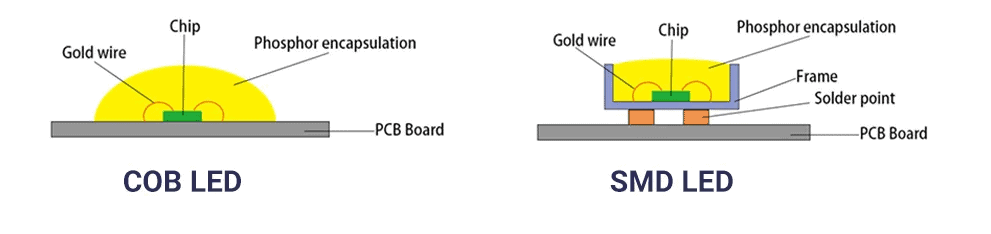
Therefore, during LED manufacturing, the coating process for fluorescent powder is very important. If the process lacks precision and the phosphor layer is applied too thick, the color will be warmer (yellow); if the phosphor layer is applied too thin, it will allow more blue light to pass through, and the color will be colder (blue).
Additionally, if the phosphor is applied unevenly, the LED center will look white while the edges look yellow.
Color Temperature Deviation
What is color temperature?
Color temperature refers to the phenomenon observed under standard physical conditions: when a standard blackbody is heated to a certain temperature, it begins to emit a dim light; as the temperature rises further, the color of the light shifts to yellowish-white, white, and then bluish-white. We define the specific color of light emitted by a blackbody at a given temperature as the color temperature of that light.
As shown in the figure below:
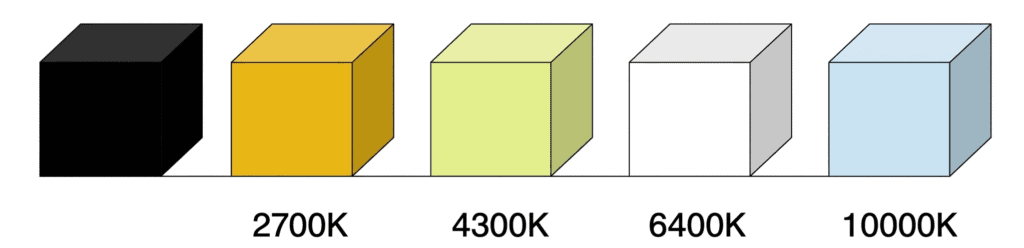
Based on the above definition and picture, we find out that the color temperature decides the color of the light, which is what we refer to as “Yellow Light,” “White Light,” “Warm Light,” “Cool Light” in our daily life.
So, we can see that the same face of a person, under different color temperatures of light, turns out different, as shown in the figure below:
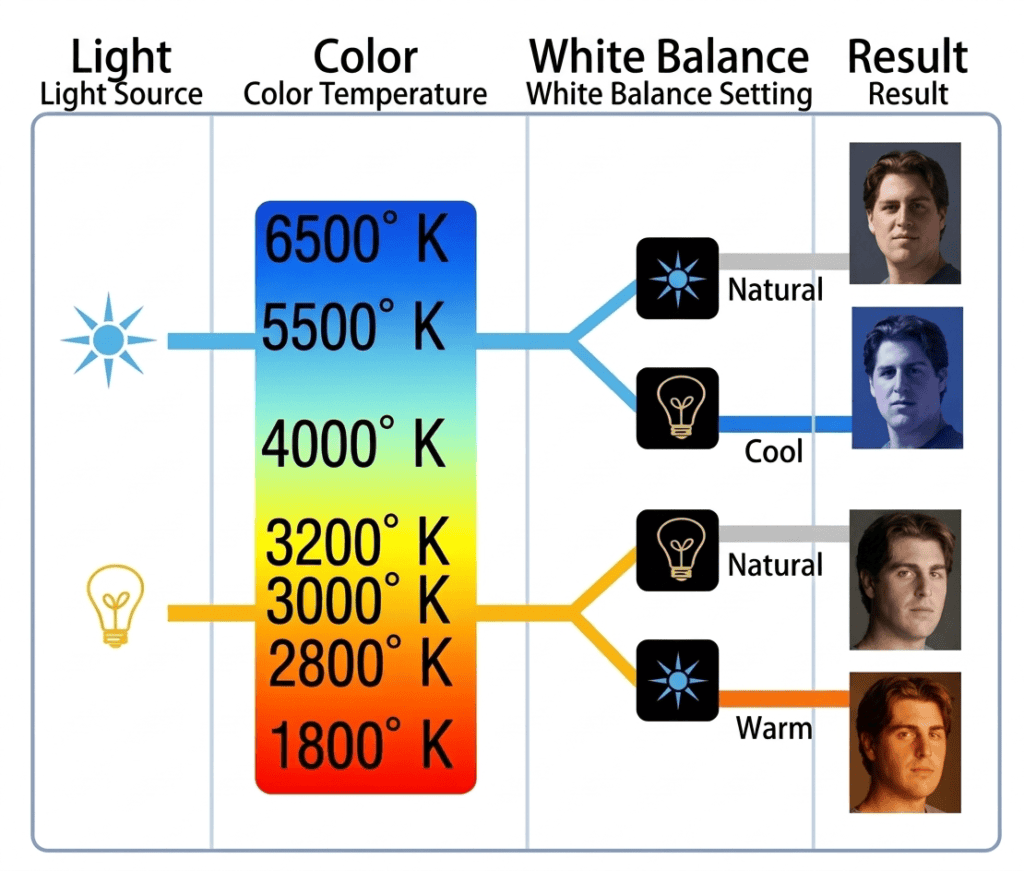
And because of the different treatment of the color temperature among the manufacturers, the color of the light deviates.
As shown in the figure below, the three points A, B, and C on the blue line belong to the same 3000K color temperature. Point A is exactly 3000K warm white light, while point B is slightly greenish at 3050K, and point C is slightly reddish at 2950K. They differ by approximately 50K. Although the color temperature difference is not significant, the actual perceived colors are distinct.

Regarding this color deviation, the concept of SDCM was proposed by scientist Macadam in 1942, which is used to evaluate color consistency. “Steps” are used as the unit of measurement. Color differences within 3 steps cannot be perceived by the naked eye; however, when it comes to 5~7 steps, the contrast becomes very obvious.
Aside from the LEDs themselves, certain external factors can also cause “color differences”.
Voltage Drop
For some long LED channel letters or LED strips, if the power cables are not thick enough, the current will diminish as it travels to the far end. Insufficient voltage can result in reduced brightness of the LEDs at the end, and even cause color variation, especially in RGB LED strips.
Panel Differences
If the external acrylic panels of the LED channel letters are not from the same production batch, or if their transmittance is not the same, it will also cause color variation.
Aging Rate
Due to natural factors, such as exposure to sunlight, wind and rain, or just heat sinking issues, the LEDs and phosphors will gradually age, causing the color to slowly turn yellow or dim.
Part 2: How to Avoid Color Variation?
So when we order products such as LED channel letters, Faux Neon Letter Signs or Light Box Signs, how can we avoid color variations?
We suggest you follow the 4 points below:
First, when undertaking large-scale LED signage projects, select high-quality LED modules. High-quality LED modules typically ensure superior binning and phosphor coating processes, featuring a low SDCM value. This guarantees consistent color temperature and hue across the entire strip and between different production batches.
Second, utilize high-quality power supplies and cables to prevent voltage drop issues.
Third, for the same project, use the same panel type from the same batch to ensure the same light transmittance.
Fourth, to avoid color differences during future maintenance, it is recommended to order spare parts from the same batch alongside the initial product order.
Part 3: The Four-Tier “Error-Proofing Mechanism” for Order Communication
Besides the four suggestions for avoiding color variation mentioned in Part 2, there is another crucial point:
Both parties should use the same set of color-related terms to ensure that their understanding of color is completely aligned.
To ensure complete alignment of understanding between the client and the factory, the industry typically employs the following four-tier “error-proofing mechanism”:
Using Core Physical Parameters
For white light, it is crucial to align on specific color temperatures. Do not just say “warm white”, you have to specify the exact Kelvin value, such as “3000K”;
For colored light, avoid vague descriptions like “red”, you can add the wavelength parameter, for example, “620nm~625nm”.
Citing International Standard Color Charts
If the client has specific requirements for the aesthetic appearance (such as the color of the acrylic when the lights are off, or the paint finish), a standard color chart must be referenced, such as Pantone or RAL.
Restrict SDCM and Bin
Even with the same color temperature, the light can still look greenish or purplish. In this case, it is necessary to constrain the Color Tolerance (SDCM) to ensure it is within a 3-step MacAdam ellipse. Additionally, ask the factory to provide the Bin Code; this ensures the color differences are imperceptible to the naked eye, even across different batches.
The Simplest and Most Effective Method: Sampling.
Of course, if you are unable to do any of the above, there is no need to worry; there is still one highly effective method: produce one or two samples before final production.
Take Away
Purchasing LED signage products, such as LED Channel Letters, Faux Neon Letter Signs, or Light Box Signs, is far more complex than one might imagine.
To ensure your LED signage delivers the optimal luminous performance and truest colors, the following factors are critical:
- High-quality raw materials
- Referencing standard color charts
- Strict constraints on core physical parameters
- Prototype confirmation
As a veteran expert in this field, FT Signage has extensive experience in both LED signage manufacturing processes and export regulations:
- Use UL-certified LED compliant
- 24 hours of aging testing before delivery
- Free samples before batch order
Ready to light your brand with color and durability? Welcome to contact us to discuss your customization needs and explore further details.